
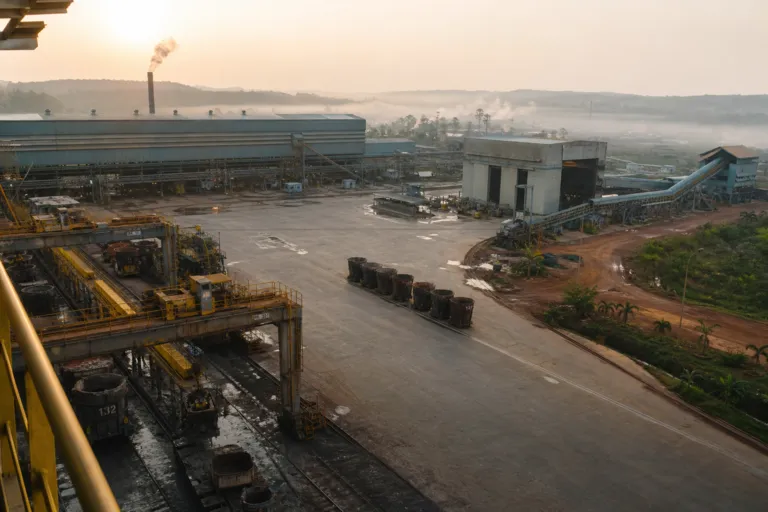
Indonesia’s downstreaming agenda is no longer a single-commodity story. After nickel became the flagship, the government has extended the approach to other minerals, including copper. One policy signal is explicit: export bans have been enacted on raw bauxite and on copper concentrate, with the goal of forcing the construction of domestic smelters. In parallel, officials frame the approach as selective, not automatic. In a 2026 briefing cited by Tempo, the Ministry of Energy and Mineral Resources described downstreaming as targeted to economic considerations while also pointing to new potential markets for processed minerals over 2026–2030, including data centers and energy storage systems.
Fresh output numbers also show why copper is now in focus. As of September 2026, Indonesia had produced 114.9 million tons of copper ore, 1.47 million tons of copper concentrate, and 257 kt of copper cathodes, according to figures reported by Tempo. The same disclosure paired copper with comparable production snapshots across other commodities, such as 23.43 million tons of bauxite ore and 34.6 kt of refined tin, reinforcing that the downstreaming push is being positioned as a multi-mineral program. Read together, the data suggests copper policy is being developed inside a broader industrial narrative that is trying to connect upstream extraction to domestic processing outputs and end-markets.
Investment Signals: Copper Joins the Downstream Capital Stack
Capital allocation points to copper’s rising role in the national downstreaming portfolio. One dataset cited in an Indonesia downstream investment outlook placed total mineral-sector downstream investment at Rp206.5 trillion in the first half of 2026. In that same breakdown, copper downstreaming was listed at Rp37.4 trillion, alongside Rp30.2 trillion for iron and steel and Rp5.9 trillion for silica sand. A separate quarterly snapshot in the same source reported realized investment of Rp16.7 trillion for copper, while bauxite was reported at Rp40.1 trillion in Q2 2026 and nickel at Rp29.4 trillion. Separately, Kompas also cited Rp206.5 trillion for mineral downstreaming investment as of the first semester of 2026, while noting there were 28 integrated smelters spanning commodities that include copper.
The logic behind pushing copper into domestic processing also faces a structural challenge on the demand side. A 2026 study on copper downstreaming in Indonesia found that 70% of cathode production is still export-oriented due to low domestic manufacturing absorption. That gap matters because it implies that simply increasing smelting and refining does not automatically translate into deeper domestic value chains. The same study linked downstream targets to long-run reserve resilience. It estimated potential resource-to-reserve conversion of approximately 4.318 billion tons and, accounting for ore grade decline, projected the life of Indonesia’s copper ore reserves could extend until 2077 under its simplified projection framework.
Nickel’s experience remains an important reference point for how Indonesia frames downstreaming outcomes and trade-offs. One policy note described nickel’s export ban as having compelled investment exceeding $30 billion into local smelters and HPAL facilities, while Kompas reported nickel derivative export value rising from $3.3 billion in 2017 to $33.9 billion by 2024. At the same time, Kompas also highlighted concerns that much of the output remains intermediate or semi-finished goods that are exported, leaving gaps deeper in the industrial tree. For Indonesia copper smelter downstreaming, that lesson is clear: policy can pull processing onshore, but building stronger domestic absorption and product depth is a separate challenge that will shape how far the copper push ultimately goes.
Why is Indonesia extending downstreaming policy to copper?
What copper production figures were reported for Indonesia as of September 2026?
How much investment was associated with copper in Indonesia’s downstreaming data for H1 2026?
What does research say about domestic absorption for copper cathodes in Indonesia?
What does Indonesia copper smelter downstreaming face as a long-term constraint or support factor?