The Philippine BPO sector is entering an AI-driven reset, and the numbers show both pressure and momentum. The industry directly employs around 1.8 million workers and generates roughly $40 billion in annual export revenues, contributing about 7 to 8% of GDP. Another 2026 snapshot puts employment at approximately 1.9 million, with revenue having surpassed $40 billion. Yet risk is real: one analysis warns that around 1 million BPO-related jobs could be vulnerable to automation by 2030, especially because an estimated 70% of revenues are still tied to voice-based services.
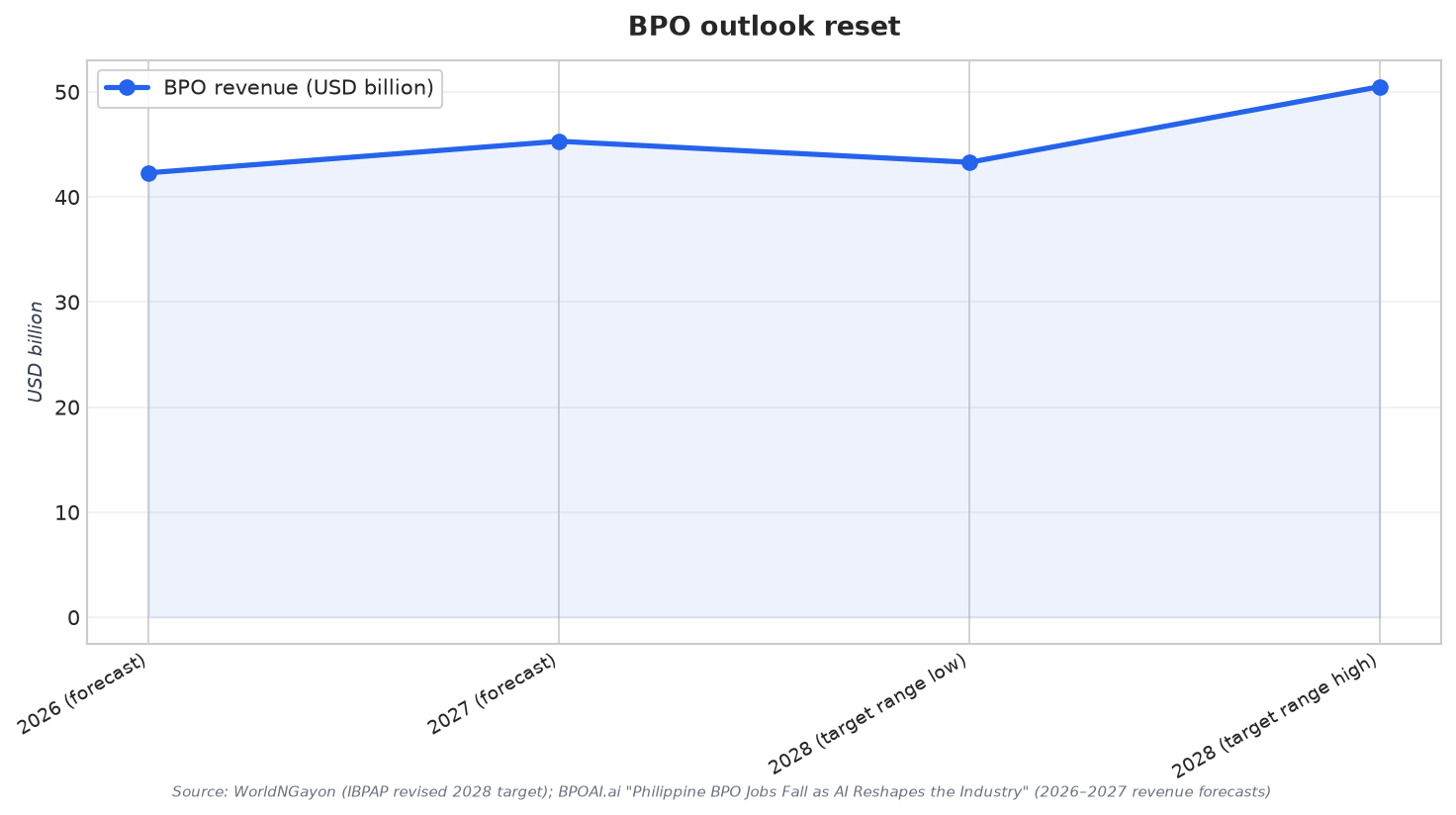
Targets and forecasts are also being revised in ways that reflect the changing work mix. IBPAP cut its 2028 BPO revenue target from $59 billion to a $43.3 billion to $50.5 billion range, a downgrade from its 2022 roadmap. On jobs, a separate update says the 2028 forecast was cut to 2.14 million from 2.5 million as automation reshapes outsourcing demand. For the nearer term, IBPAP expects around $42.3 billion in revenue and 1.96 million jobs in 2026, rising to $45.3 billion and 1.99 million roles in 2027. These are not collapse numbers, but they imply growth that can decouple revenue from headcount.
What AI Will Automate First — and What Stays Resilient
Experts and industry groups broadly agree on which tasks are most exposed. The Philippine AI Business Association’s Dominic Vincent D. Ligot said the immediate danger is not the disappearance of the sector, but “the automation of routine tasks, fewer entry-level positions, and growth in revenues without comparable growth in employment.” He flagged basic customer inquiries, password resets, data entry, transcription, appointment scheduling, and templated chat and e-mail support as vulnerable, plus simple claims processing, billing, and first-line technical support. IBPAP echoed that basic customer service and transactional back-office functions face the greatest exposure, while work requiring judgment, accountability, empathy, and domain expertise is more resilient.
In context, AI’s impact on the Philippines is also shaped by external concentration and global trends. One sector profile estimates the Philippines captures roughly 15% of global outsourcing market share, with an estimated 70% of BPO revenue flowing from US clients, making client-side automation a direct transmission channel. The IMF estimated that one-third of Philippine jobs are exposed to AI displacement, with BPO workers among the most vulnerable. Another projection says between one and three million BPO and IT outsourcing workers across India and the Philippines face disruption by 2030, underscoring that the disruption is regional, not only local.
Still, the next wave is not only about defense; it is also about upgrading. IBPAP described AI as accelerating the sector’s transition “from capacity to capability and from volume to value,” with demand growing for higher-value services that combine AI with human judgment, critical thinking, creativity, empathy, and complex engagement. Government framing points the same direction: NEDA estimated PHP 2.6 trillion (roughly $45 billion) in annual efficiency gains if AI adoption moves quickly across key sectors, including retail, logistics, manufacturing, and financial services. The practical question for the Philippines BPO AI transformation is whether firms and workers can close skills mismatches fast enough as routine work is automated.
Is AI a threat to Philippine BPO jobs or mainly a task shift?
Which BPO services are most exposed to automation in the Philippines?
What updated targets has IBPAP set for BPO revenue and jobs?
How does client concentration shape the Philippines’ AI-driven BPO risk?
What does the Philippines BPO AI transformation mean for higher-value work?