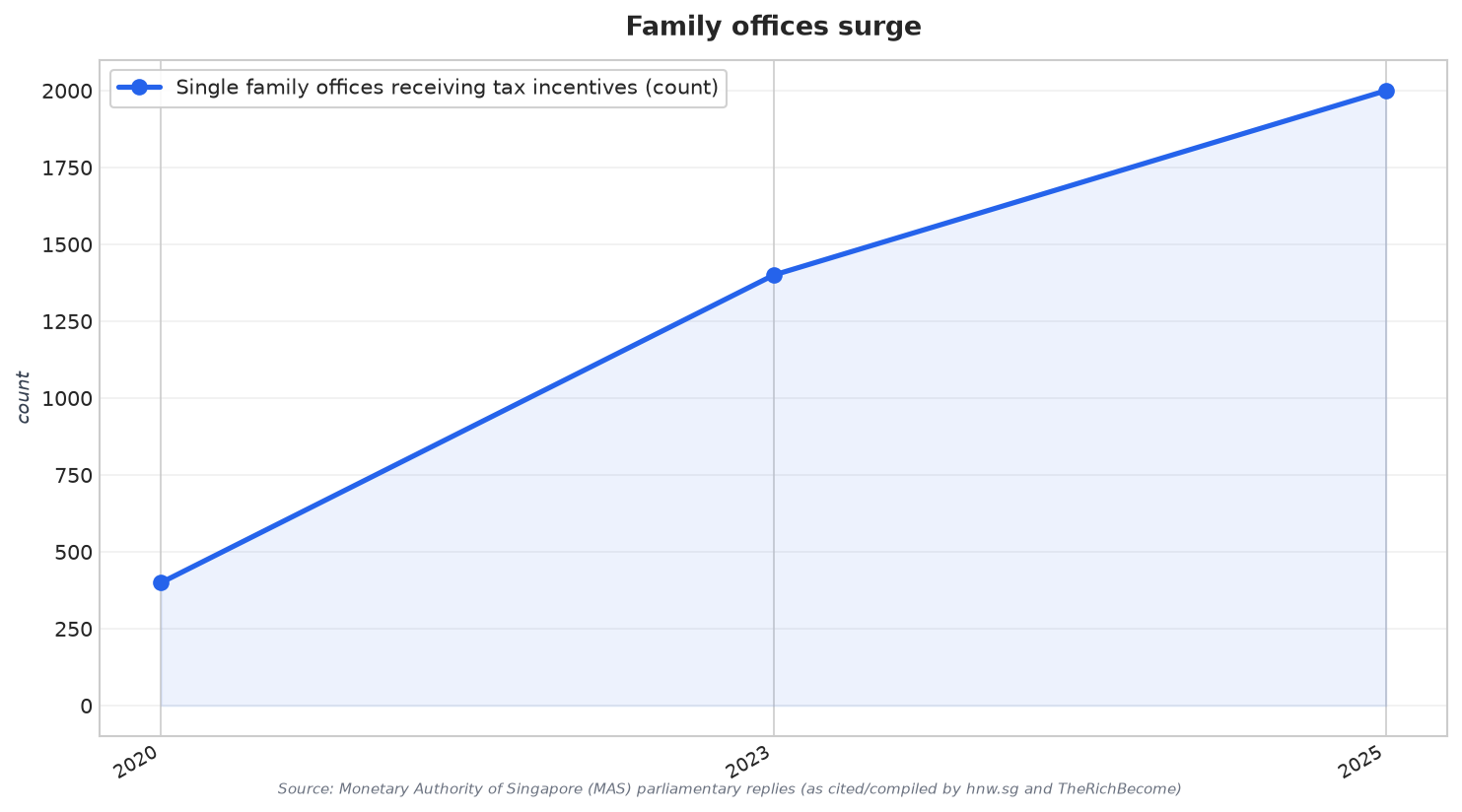
Singapore’s rise as a Singapore family office hub is best understood through the official counts that exist, and the gaps that still remain. MAS parliamentary replies cited in multiple reports show single family offices receiving tax incentives increased from around 1,400 at end-2023 to more than 2,000 by end-2025. Another set of figures describes an earlier stage of the same wave, with growth from roughly 400 at end-2020 to approximately 1,400 by end-2023. The numbers point to institutional momentum, but they do not directly measure how many wealthy individuals physically relocated, or how much wealth migrated with them.
Zooming out, Singapore’s broader asset-management industry provides the backdrop for why family offices keep clustering in the city. MAS data summarized by industry sources says total assets under management grew 10.1% in 2025 to a record S$6.7 trillion. Earlier MAS-reported totals show SGD 5.4 trillion at end-2023, up from SGD 4.9 trillion a year earlier. The same dataset frames Singapore as an international booking centre, with around 78% of mandates sourced from outside Singapore and 89% invested outside the city-state (end-2023). That global-facing profile helps explain why family offices can be set up locally while deploying capital regionally and beyond.
Where the Money Comes From, and How the Rules Are Changing
MAS has also disclosed the origin mix of money managed through tax-incentivised single family offices: it comes predominantly from the Asia-Pacific region, followed by Europe and then the Americas. That ordering matches Singapore’s competitive pitch as a stable and predictable platform within Asia’s time zone and legal environment. At the same time, the policy framework has been evolving. A July 2023 tightening to Sections 13O and 13U is cited as a recalibration point, alongside the August 2023 SGD 3 billion money laundering case and subsequent “AML reset” commentary. MAS Deputy Chairman remarks on 29 September 2025 noted that most new applications were approved within three months, before revised conditions were issued via FDD Cir 05/2026 on 31 July 2026 for new applications from 1 August 2026. From 15 June 2026, single family offices also fall under a new class exemption framework requiring MAS notification and annual returns.
Structures matter as much as headline office counts, and Singapore’s VCC regime has become a key part of the operating toolkit. MAS reported that as of 31 December 2025, 1,406 VCCs had been incorporated in or redomiciled to Singapore, covering 3,443 sub-funds and managed by more than half of licensed fund management companies. This matters for family wealth because it signals depth in fund administration, governance processes, and manager participation, rather than a niche product used by only a small set of players. It also suggests that Singapore’s wealth ecosystem is being built not just on arrivals, but on scalable structures that can house multi-asset strategies over time.
The boom is also changing what family offices look like on the inside. One account, citing financial data company Dakota, says about 600 new single family offices were added in Singapore in 2024 alone, taking the total to over 2,000 and describing that as a 400% increase on 2020. Alongside that growth, the same discussion highlights increased use of external managers, technology, and formal investment committees, reflecting professionalisation and next-generation involvement. Yet Singapore’s discipline story is part of the reshaping too: MAS has ceased tax incentives for two family office funds linked to US-sanctioned individuals, and it rejected about 3% of roughly 1,300 applications across three years, while stating it has not observed a net outflow. The result is a hub narrative defined by scale, scrutiny, and maturing governance.
Why is Singapore seen as a leading family office hub in Asia?
How many single family offices have received tax incentives in Singapore?
Where does the money in Singapore’s tax-incentivised family offices mainly come from?
What do VCC numbers suggest about Singapore’s wealth-management ecosystem?
How has MAS tightened oversight while processing family office growth?