





/ Overview
Our Market Research Approach in ASEAN
Our market research approach in ASEAN integrates secondary research, primary fieldwork, market sizing, and commercial assessment to help organisations evaluate business opportunities across Southeast Asia. Our five-step methodology examines market demand, competitive conditions, customer requirements, and implementation considerations before translating findings into practical recommendations.
A promising market is not necessarily the most attractive investment. Commercial viability also depends on pricing, regulatory barriers, operating costs, distribution access, and the resources required to compete. We assess these factors within individual countries and across selected ASEAN markets, helping businesses distinguish market potential from opportunities they can realistically pursue.
/ Our Method
Our Market Research Methodology in 5 Steps
Our methodology follows five connected stages, with the scope, research methods, and level of analysis adapted to the client’s objectives, sector, and target countries.
-
Define the business decision
We clarify the decision the research must inform, from market entry and regional expansion to investment, pricing, or partner selection. The study’s objectives are translated into research questions, country priorities, and measurable assessment criteria.
Output: Research scope, objectives, and research plan.
-
Desk research
We examine national economic statistics, industry publications, company disclosures, regulatory requirements, and trade information. Data is reviewed for coverage, reporting differences, and suitability for comparing the markets under consideration.
Output: Preliminary market assessment and research gaps.
-
Primary research & fieldwork
We investigate commercial realities through interviews with buyers, distributors, sector specialists, and business decision-makers. Surveys, site visits, and field observations provide further evidence on demand, purchasing practices, and routes to market.
Output: Primary research findings and market insights.
-
Market sizing & triangulation
Where relevant, we develop country-level top-down and bottom-up estimates, testing demand assumptions against purchasing volumes, pricing, industry evidence, and stakeholder feedback before comparing or consolidating market values.
Output: Market sizing model, validated assumptions, and supporting analysis.
-
Recommendations & decision support
We assess the findings against commercial attractiveness, strategic fit, investment requirements, and execution risks. The resulting recommendations identify where to focus, what to prioritise, and which decisions require further validation.
Output: Research report, strategic recommendations, and decision-support materials.
/ Data Sources
Which Data Sources Do We Use in ASEAN?
Research across ASEAN requires reliable information from national authorities, industry organisations, commercial sources, and direct market engagement. We examine differences in definitions, reporting periods, and data completeness before comparing countries or drawing regional conclusions.
| Source type | Examples | Research application |
|---|---|---|
| Official statistics | ASEANstats, Statistics Indonesia (BPS), Singapore Department of Statistics (SingStat), Thailand National Statistical Office (NSO), national statistics agencies | Population, economic indicators, trade, and sector-level data |
| Ministries & regulators | National investment authorities, ministries of trade and industry, central banks, and sector-specific regulators | Investment policies, licensing requirements, and sector developments |
| Chambers & industry bodies | ASEAN Business Advisory Council (ASEAN-BAC), national chambers of commerce, manufacturing federations, and sector associations | Industry networks, market participants, and potential partners |
| Industry & company data | Corporate disclosures, financial reports, industry publications, and commercial research databases | Competitive landscape, market performance, and industry benchmarks |
| Primary research | Executive interviews, customer surveys, site visits, and market observations in selected countries | Customer needs, purchasing behaviour, pricing, and validation of secondary findings |
/ Fieldwork
How We Run Primary Research and Fieldwork in ASEAN
Primary research across ASEAN involves engaging respondents in markets with distinct languages, purchasing practices, business networks, and research conditions. We adapt questionnaires, interview formats, and fieldwork arrangements to local circumstances while maintaining comparable research objectives where several countries are involved.
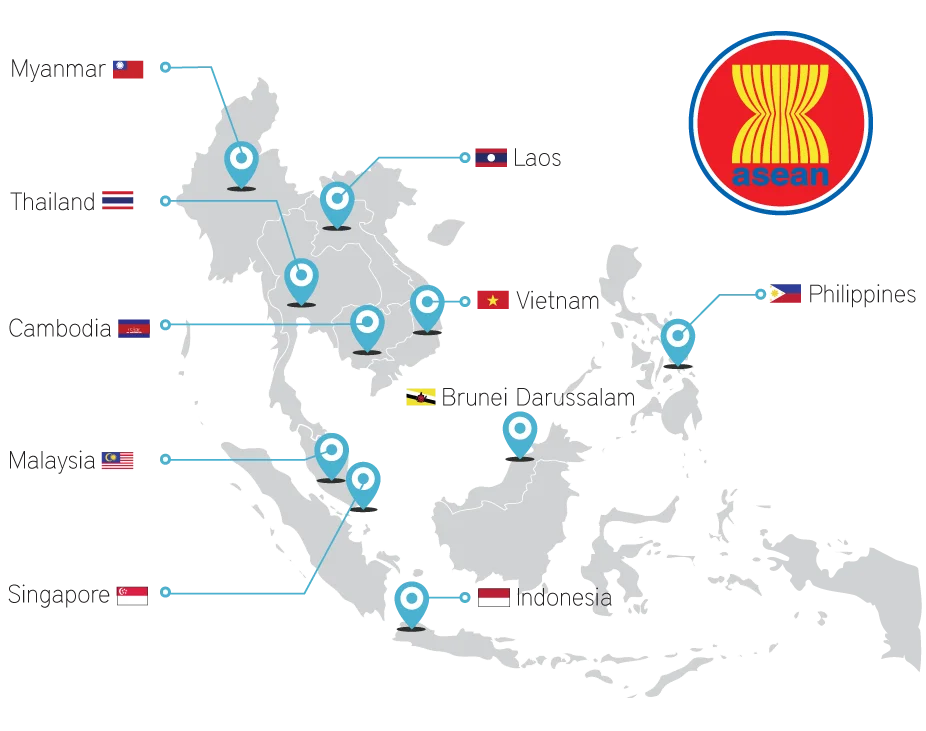
Depending on the assignment, research may be conducted across Indonesia, Vietnam, Thailand, Malaysia, Singapore, the Philippines, Cambodia, Laos, and other relevant markets. Respondents can include senior executives, procurement teams, distributors, retailers, industry experts, institutional stakeholders, and consumers.
Methods
In-depth interviews, quantitative surveys, focus groups, site visits, distribution audits, and commercial observations, selected according to research objectives.
Languages
Research may be conducted in English and relevant local languages, with translation and local-language support arranged according to country and respondent requirements.
Scheduling
Fieldwork planning accounts for national holidays, local business schedules, respondent availability, and coordination across multiple markets.
Respondent recruitment
Participants are identified through country-level industry mapping, business networks, professional associations, and targeted recruitment based on agreed screening criteria.
/ Market Sizing
How We Size and Validate a Market in ASEAN
We develop market estimates by combining economic indicators, sector activity, customer demand, and transaction-level evidence. For regional studies, calculations are built around clearly defined country and service boundaries, allowing market values to be compared without overlooking differences in pricing, purchasing patterns, or data coverage.
Top-down
Begin with country-level statistics, sector expenditure, and relevant industry data, then narrow estimates by geography, target market, customer segment, and addressable demand.
Triangulation
Review discrepancies between estimates, examine differences in market definitions and assumptions, and cross-check findings with industry participants and additional evidence.
Bottom-up
Estimate market value through potential customer numbers, expected utilisation or purchase frequency, and average transaction values supported by direct market research.
Market Sizing: Electric Vehicle Charging Services in ASEAN
Business question
What is the estimated annual market value of public electric vehicle charging services across Thailand, Malaysia, Indonesia, and Vietnam?
Top-down estimate
US$460m
Public charging expenditure and EV adoption assumptions
Bottom-up estimate
US$410m
Public charging sessions × average revenue per session
Triangulation
Both estimates are examined against EV fleet adoption, public charging utilisation, electricity consumption per session, and prevailing charging tariffs. Differences between countries are reviewed before consolidating the market estimates.
Estimated market range
US$410–460m
Decision implication: Prioritise markets and charging locations based on potential utilisation, revenue opportunities, and infrastructure investment requirements.
/ By Decision
How the Method Changes by Business Decision
Every strategic decision requires a specific mix of market evidence, financial assessment, and stakeholder insight. We adapt the methodology to clarify not only whether an opportunity exists, but also the resources, commercial conditions, and risks involved in pursuing it.
| Your decision | Method mix | Deliverable | Service page |
|---|---|---|---|
| Is there enough demand? | Market sizing + customer interviews + demand validation | Market assessment | Market Research → |
| Should we enter, and how? | Country screening + competitor analysis + regulatory review + channel interviews | Entry options and roadmap | Market Entry Strategy → |
| Is the project viable? | Demand forecasting + CAPEX/OPEX modelling + investment risk assessment | Feasibility report | Feasibility Study → |
| How do we plan for future growth? | Market scenarios + capability assessment + investment prioritisation | Strategic growth roadmap | Strategic Planning → |
| Is this acquisition worth it? | Commercial due diligence + competitor assessment + customer and management interviews | Due diligence report | Mergers and Acquisitions → |
| Where do costs hit our margins? | Value chain mapping + supplier analysis + cost and logistics benchmarking | Value chain map and priorities | Value Chain Analysis → |
| Who is gaining ground? | Competitor profiling + pricing analysis + customer research | Competitive benchmark | Competitive Benchmarking → |
| Which partner or distributor? | Distributor screening + partner evaluation + stakeholder interviews | Partner shortlist | Distribution & Strategic Partnership → |
| How do consumers make purchasing decisions? | Consumer segmentation + surveys + channel and purchasing behaviour analysis | Consumer profiles and purchasing insights | Consumer Behavior Analysis → |
/ By Sector
How the Method Changes by Sector
Research methods vary according to industry economics, investment requirements, regulatory conditions, and customer needs. We select the appropriate sources and analytical techniques to evaluate sector-specific opportunities across ASEAN markets.
Construction
Infrastructure pipeline reviews, project demand forecasting, contractor interviews, and material procurement and cost benchmarking.
View sector →Healthcare
Patient demand modelling, healthcare capacity reviews, service gap analysis, and provider and regulatory benchmarking.
View sector →Energy
Electricity demand projections, generation and grid investment reviews, regulatory assessment, and technology and value chain analysis.
View sector →Supply Chain & Logistics
Regional freight mapping, distribution cost analysis, logistics facility assessment, and cross-border network benchmarking.
View sector →Transport & Mobility
Passenger demand analysis, transport network modelling, infrastructure assessment, and mobility operator benchmarking.
View sector →/ Timelines
How Long Does Market Research in ASEAN Take?
A focused ASEAN market research engagement generally requires 6–12 weeks, depending on the number of countries, market complexity, stakeholder availability, and depth of analysis. Extensive multi-country fieldwork, commercial feasibility studies, and projects requiring detailed financial modelling may take longer.
Research programmes are scheduled around scoping, evidence collection, stakeholder engagement, analysis, validation, and reporting. For regional engagements, country research activities may be coordinated in parallel, with milestones established for comparative analysis and management review.
| Project type | Typical duration | Typical team |
|---|---|---|
| Desk-led market assessment | 4–6 weeks | Project manager + research analysts |
| Interview-based market study | 6–10 weeks | Project manager + analysts + sector specialists |
| Large-scale survey / fieldwork | 10–16 weeks | Research team + country fieldwork coordinators |
| Feasibility study | 10–16 weeks | Project manager + sector and financial specialists |
/ Method in Practice
How Our Research Methods Work in Practice
Healthcare
Advancing AI-Enabled Healthcare Services Across ASEAN
Issue
A private hospital group operating across several ASEAN markets needed to address increasing patient volumes, limited specialist availability, and administrative inefficiencies. Uneven diagnostic capacity between flagship hospitals and smaller facilities also affected patient access, referral processes, and service delivery.
Approach
The engagement involved clinical workflow assessments, digital readiness reviews, and analysis of healthcare regulations across the group’s operating markets. AI-assisted diagnostic tools and telemedicine solutions were piloted, with performance assessed through turnaround times, referral patterns, and patient experience indicators.
Recommendation
We recommended establishing a central digital health function, strengthening data governance, and expanding AI-supported diagnostics and telemedicine through a phased implementation model. Partnerships with technology providers and continuous clinical training were also prioritised to support sustainable adoption.
Engagement ROI
The initiative improved access to specialist care and reduced diagnostic delays and administrative workload. Smaller facilities benefited from faster specialist support, while workflow improvements enabled clinical teams to devote more time to patient care. The engagement also established a stronger foundation for scaling digital healthcare services across the hospital network.
Energy
Strengthening Power Grid Modernisation in Vietnam
Issue
A major power utility in Vietnam needed to modernise its electricity network as industrial demand increased and renewable energy capacity expanded. Grid constraints, ageing infrastructure, and limited real-time monitoring complicated decisions on reliability, investment priorities, and renewable energy integration.
Approach
The assessment combined electricity demand forecasting, infrastructure reviews, renewable energy pipeline analysis, and investment scenario modelling. Technical, financial, and regulatory considerations were evaluated with the utility’s planning and engineering teams to identify priority network improvements.
Recommendation
We recommended phased investment in smart-grid monitoring, transmission reinforcement, and energy storage in areas facing greater renewable integration constraints. The roadmap also prioritised stronger demand forecasting, improved grid flexibility, and engagement with relevant technology and regulatory stakeholders.
Engagement ROI
The engagement established a prioritised modernisation roadmap that helped direct investment towards critical network requirements. Improved forecasting and grid visibility supported reliability planning and reduced exposure to renewable curtailment risks, while the phased approach strengthened the utility’s ability to respond to future electricity demand.
Transport & Mobility
Improving Urban Transport Efficiency in Metro Manila
Issue
A transport operator serving Metro Manila needed to improve service reliability and respond to changing commuter demand. Traffic congestion, fragmented mobility services, and new mass-transit developments created challenges in route planning, fleet allocation, and long-term competitiveness.
Approach
The study examined passenger movement patterns, route-level demand, fleet utilisation, and network performance. Alternative service and capacity scenarios were modelled, alongside opportunities for electric vehicle adoption and integration with emerging mass-transit infrastructure.
Recommendation
We recommended restructuring priority routes around observed demand, improving scheduling, and introducing digital fleet-management capabilities. A phased electric mobility roadmap and opportunities for feeder services were also developed to strengthen connectivity with the wider transport network.
Engagement ROI
The resulting strategy improved service planning and operational efficiency through demand-based route adjustments and better fleet management. It also provided a practical framework for reducing passenger waiting times, strengthening vehicle utilisation, and preparing the operator for further integration with Metro Manila’s evolving transport system.
Want to know who we are? About Market Research ASEAN →
Frequently Asked Questions
-
We develop top-down and bottom-up estimates using national statistics, sector data, customer demand, and primary research. Estimates are checked at the country level, with differences in pricing, market definitions, and purchasing patterns examined before calculating a combined regional market size.
-
Our research draws on ASEANstats, national statistics agencies, government and regulatory publications, company reports, industry databases, and primary research. We assess each source for reliability, relevance, and comparability, particularly when a study covers several countries.
-
We evaluate competitors through market mapping, pricing comparisons, customer interviews, and distribution analysis. Benchmarking considers local and international competitors, their market positioning, commercial capabilities, and differences in competitive conditions across the target countries.
-
We combine multilingual consumer surveys, segmentation analysis, and purchasing behaviour research to understand preferences, purchase drivers, price sensitivity, and channel usage. Findings are compared across countries to highlight differences between national markets, helping businesses identify priority segments and refine product, pricing, and marketing strategies.
-
Interviews may be conducted in English or relevant local languages, depending on the country, respondent profile, and research requirements. Translation and local-language fieldwork support can be arranged to help ensure accurate data collection and interpretation.
-
Yes. Depending on the project, fieldwork may cover Indonesia, Vietnam, Thailand, Malaysia, Singapore, the Philippines, Cambodia, Laos, and other relevant markets. The research design and geographical coverage are determined by project objectives and the availability of target respondents.
-
Focused market research assignments generally take 6–12 weeks, depending on the number of countries, methodology, and stakeholder requirements. Multi-country surveys, complex feasibility studies, and detailed commercial assessments may require 10–16 weeks or longer.
-
Where necessary, we may work with specialised local research partners to support respondent recruitment, survey administration, and fieldwork coordination. Research design, data quality, analytical review, and recommendations remain subject to the agreed project management framework.
/ Contact Us
Turn Your Next Opportunity in Southeast Asia into a Clear Strategy
/ Follow Us