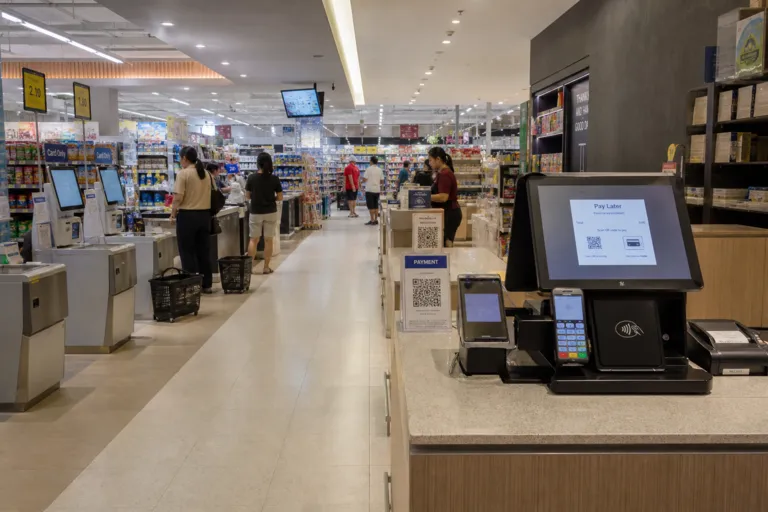
Embedded finance in Southeast Asia is no longer an experiment. A study by HSBC, Google Cloud, and PCMI (fielded between December 2024 and May 2025) found that 77% of consumers in Southeast Asia use embedded finance through wallets, BNPL, or in-app loans, and 75% call it “very important” or “useful.” This shift is reinforced by changes in how people pay. A November 2025 survey cited by SpinDepth reports that digital payments through e-wallets and account-to-account systems now account for 58% of cashless transactions across Southeast Asia, overtaking credit cards by transaction value. Retail is where these behaviors become visible, because finance is increasingly delivered inside the checkout and inside everyday apps.
The biggest distribution advantage is often the interface consumers already open daily. SpinDepth describes how platforms that began as ride-hailing, e-commerce, and messaging tools now deliver lending, insurance, savings products, and payment infrastructure to tens of millions of users across ASEAN’s six largest economies. Examples include Grab’s financial services arm operating across Singapore, Malaysia, Indonesia, the Philippines, Thailand, and Vietnam, as well as GoPay embedded in Gojek’s flows in Indonesia. Even banks are adapting to this distribution reality. SpinDepth notes Standard Chartered’s nexus platform is powering white-labeled banking infrastructure for ecosystem partners across Indonesia and other Southeast Asian markets, aligning product delivery with platform-led journeys.
BNPL Becomes a Checkout Default, Not a Niche Add-On
BNPL sits at the point where payments and credit meet, which is why it is pulling embedded finance into mainstream retail adoption. In the HSBC–Google Cloud–PCMI study, 66% of consumers said they want to see BNPL more often when making purchases, and 48% want to see instant loans. Importantly, the study also challenges simplistic assumptions about who uses BNPL. It found 61% of BNPL users are in the top two income quartiles, and BNPL users also show higher credit card ownership than average: 69% versus 45%. The same profile appears more digitally confident, with 75% using digital platforms to make transactions daily, helping explain why BNPL can scale quickly inside app-based commerce.
Merchants report clear commercial upside when they place BNPL in the purchase flow. TechWire Asia reports that, in a survey, 51% of retail businesses said BNPL raised their revenue by at least 25%. Asian Banking & Finance reports the same result: 51% of retail-oriented businesses said BNPL increased revenue by at least 25%. That commercial signal is arriving alongside more formal oversight. TechWire Asia notes Malaysia’s Consumer Credit Commission is formalising BNPL oversight, suggesting that governance is evolving as adoption expands. For retailers, this combination of revenue impact and clearer rules can accelerate rollout decisions across online and in-app channels.
Across the wider Asia Pacific context, embedded finance is also scaling as a market category. ResearchAndMarkets data, referenced by SpinDepth and repeated in a GlobeNewswire report, estimates the Asia Pacific embedded finance market reached $288.8 billion in 2025 and is growing at 9.1% annually, spanning payments, lending, insurance, banking, and wealth products delivered through non-financial platforms. In Southeast Asia retail specifically, SpinDepth points to Lazada and Shopee embedding BNPL and wallet features to fold short-term credit directly into checkout. In practice, this is what “ASEAN embedded finance BNPL” looks like on the ground: credit products packaged as a seamless step in the purchase journey, increasingly controlled by platforms that own the customer relationship.
How common is embedded finance usage among consumers in Southeast Asia?
What do Southeast Asian consumers say they want more of: BNPL or instant loans?
What business impact are retailers reporting from offering BNPL at checkout?
Who is driving BNPL adoption in Southeast Asia, according to the HSBC–Google Cloud–PCMI study?
What does the ASEAN embedded finance BNPL trend look like in retail channels?