
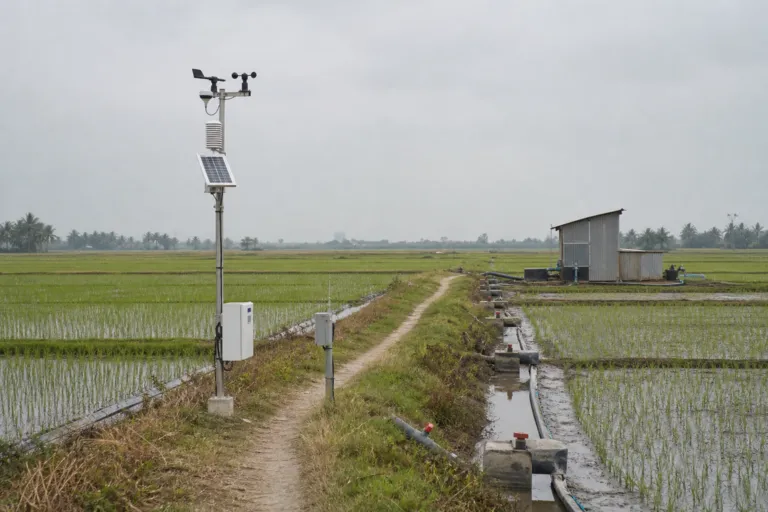
Agritech momentum in Southeast Asia is increasingly tied to precision methods that help farmers act on real-time field conditions. In precision farming, tools such as soil sensors, satellite imagery, and data analytics are used to improve input decisions and reduce waste while supporting yield improvements. One large application area is yield monitoring, which held the largest market share at 25.3% in 2025 in the precision farming market, reflecting demand for timely visibility into crop performance. Variable rate application (VRA) is also positioned as a growth area because it can tailor fertilizers, pesticides, and water to specific field conditions, with sustainability framed as a core driver behind adoption.
The investment story around Southeast Asia agritech precision farming has not been linear, and capital cycles matter. Across Southeast and South Asia (SEASA), agritech funding peaked at more than $750 million in 2022, then dropped roughly 70% by 2025 in both deal count and funding volume. Yet the same SEASA analysis argues the opportunity metrics did not move in step with capital, pointing instead to a mismatch between funding models and how value is created in local agricultural markets. The report also frames the region as fragmented rather than uniform, with distinct policy regimes and value chain dynamics that influence how quickly farm technologies can be adopted and monetized.
Vietnam’s Precision Farming Growth Shows What “Scale” Can Look Like
Within Southeast Asia, Vietnam stands out in the available sources as a specific, measured example of precision farming growth. A Vietnam-focused precision farming report cites a 12.3% CAGR for Vietnam, compared with a global 9.5% rate, and attributes that gap to agricultural modernization initiatives, rising labor costs, climate pressures, and government support for agritech adoption. The same source highlights Vietnam’s major rice and coffee exports as primary drivers of precision farming investment, with farmers looking to optimize yields while reducing input costs in high-value crops. It also positions Vietnam as a gateway market for precision farming solutions in Southeast Asia, attracting both regional and global companies.
Zooming out provides context, but it must be read carefully as global, not local, evidence. MarketsandMarkets reports that North America held more than 43% of global precision farming revenue in 2024, reflecting advanced infrastructure and high adoption, while Asia Pacific is projected to be the fastest-growing region during the forecast period, linked to modernization and smart farming uptake in countries such as China and India. Separately, global market trackers give different forecasts for the broader agritech sector. The Business Research Company expects the global agritech market to reach $58.79 billion by 2030 at 11.1%, while Zion Market Research estimates $32.13 billion in 2024 rising to $153.37 billion by 2034 at 16.92%.
For Southeast Asia, the clearest message from the sources is that adoption is being shaped by practical farm economics and by the structure of capital, not only by technology. In SEASA, agriculture contributes about 15% of GDP and employs 30–42% of the workforce, underscoring why productivity tools can have outsized importance even when venture funding cools. The SEASA report estimates that digitalisation and agritech adoption could unlock more than $90 billion in annual GDP gains in Southeast Asia alone by 2033, a reminder that yield and efficiency improvements can be macro-relevant. The near-term path, however, is likely to remain market-by-market, with precision farming use cases such as yield monitoring and VRA expanding where incentives, crops, and support align.
What is driving precision farming adoption in Southeast Asia?
How did agritech funding change across Southeast and South Asia (SEASA)?
What is Vietnam’s cited growth rate for precision farming, and what explains it?
Which precision farming application segment held the largest share in 2025?
What does the Southeast Asia agritech precision farming opportunity look like despite capital pullbacks?