
Laos built a development model around foreign-backed projects in natural resources and infrastructure. State slogans such as “Battery of Southeast Asia,” “Turning Land into Capital,” and “From Land-locked to Land-linked” captured that push, as dozens of major projects moved ahead through complex public–private partnerships in energy and transport. The results included surging resource exports tied to rural development and poverty reduction, but also a growing pile of liabilities. By 2019, Laos had accumulated an estimated US$5.25 billion in Chinese loans for projects including the Laos–China Railway and the Nam Ou Hydropower Cascade, while repayment risk remained with the Lao government.
The debt picture sharpened after the COVID-19 shock in 2020. Low foreign reserves left the Ministry of Finance vulnerable, and the sudden stop in foreign currency inflows triggered a currency depreciation–inflation spiral. Laos’ public and publicly guaranteed debt peaked at 115.7% of GDP in 2022, before declining to an estimated 94% by the end of 2024. Inflation later fell from 41% in February 2023 to single digits, the kip stabilized, and estimates put growth at 3.7–4.5% since 2023. But risk remains high: including a US$560 million deferral in 2025, cumulative deferred debt service to China since 2020 totals US$3.23 billion, around 19% of 2025 GDP.
Dams, Rail, and the China Dependence Dilemma
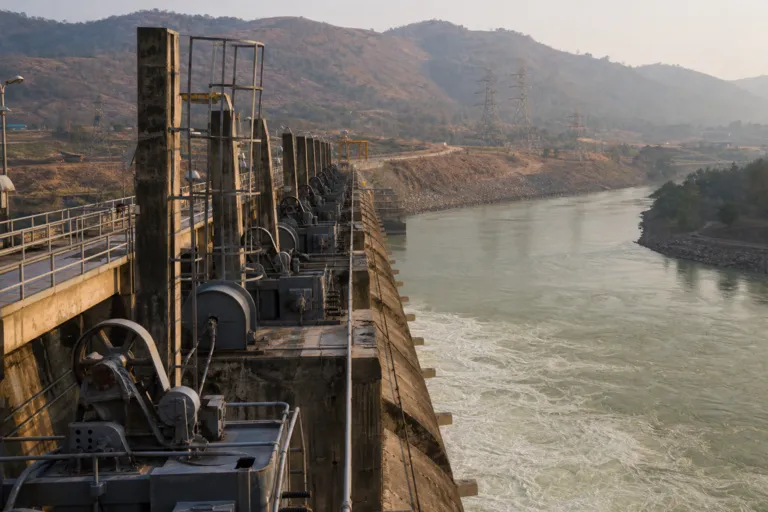
Hydropower is central to Laos’ export strategy, and it shapes the country’s external relationships. One 2026 overview notes about 80% of Laos’ power comes from dams, and about two-thirds of it is sold abroad, mostly to Thailand. China-backed infrastructure is also pivotal. The Laos–China Railway opened on December 3, 2021, running 1,035 km from Kunming to Vientiane, with 422 km in Laos, costing about US$5.9 billion; Chinese state companies own 70% of it. Another account describes the Lao section as about 414 km, costing around US$6 billion, financed in part by a US$3.54 billion loan from China’s Export-Import Bank, with the same 70/30 ownership split.
Debt exposure to China shows up across multiple estimates. One report describes China holding about half of Laos’ foreign public debt, much of it for dams and the railway. Another puts Laos’ external debt at roughly US$10.5 billion, with almost half held by Chinese creditors, and says China has helped prevent default through debt-payment deferrals worth around US$2.5 billion and a currency swap facility of roughly US$800–900 million. A separate 2026 analysis cites the Bertelsmann Transformation Index estimate of public debt at US$16.4 billion, or 108% of GDP by IMF estimates, and warns annual debt service is set to climb past US$700 million a year by 2028.
Laos is trying to reduce risk without abandoning the project-led model. Yet environmental and operational strains are rising. Hydropower dam proliferation has degraded many of Laos’ and the Mekong region’s major waterways, while inflation pressures have driven renewed deforestation as farmers move into cash crops. Mining investments have been expedited, and overloaded ore-carrying trucks have severely damaged provincial roads, as new gold and rare earth mines pose additional risks to Mekong Basin ecosystems and communities. This is the backdrop for the Laos economy China debt debate: how to keep growth and exports moving while limiting exposure to opaque liabilities and concentrated lenders.
How large did Laos’ public debt burden get relative to GDP?
How has China helped Laos avoid a formal default since 2020?
What do the sources say about the Laos–China Railway financing and ownership?
How important are dams to Laos’ electricity system and exports?
What does the Laos economy and China debt dilemma look like in numbers?