

ASEAN Africa trade reached approximately US$59 billion in 2024, eight times its level in 2000, yet represented only 0.2% of global merchandise trade. This highlights significant potential for deeper commercial integration and investment.
According to ASEAN–Africa: The Next Corridor, developed by Eurogroup Consulting in collaboration with the Alliance des Patronats Francophones (APF) and the Cambodia Chamber of Commerce (CCC), bilateral trade could reach US$112 billion by 2035 under the study's central scenario.
Launched on 14 November 2026 at the Rencontres des Entrepreneurs Francophones (REF) in Phnom Penh, Cambodia, the whitepaper examines the opportunities and business conditions shaping this emerging corridor.
ASEAN–Africa Trade: Two Complementary Growth Regions
ASEAN and Africa have distinct but complementary economic strengths. Africa combines a youthful population with substantial natural resources and expanding consumer markets, while ASEAN offers established manufacturing capabilities and international production networks.
Three areas offer potential for cooperation:
- Resources and industrial inputs: African minerals and agricultural commodities supply Southeast Asian industries.
- Manufacturing and technology: ASEAN companies contribute industrial processing, engineering, and digital expertise.
- Consumer markets: Growing demand creates opportunities in food, energy, healthcare, and infrastructure.
These complementarities provide a foundation for deeper business relationships, although successful cooperation requires competitive costs, infrastructure, and market access.
The ASEAN–Africa: The Next Corridor whitepaper explores how these strengths could support more integrated value chains.
The US$59 Billion Corridor: Growth With Untapped Potential
ASEAN–Africa merchandise trade increased from approximately US$37.5 billion in 2015 to US$59 billion in 2024, according to Harvard Growth Lab's Atlas of Economic Complexity, drawing on UN Comtrade data.
Despite this expansion, bilateral trade remains relatively modest within global commerce.
Trade is concentrated among Malaysia, Indonesia, Thailand, Vietnam, and Singapore. Major African trading markets include South Africa, Nigeria, Egypt, Côte d'Ivoire, and Morocco.
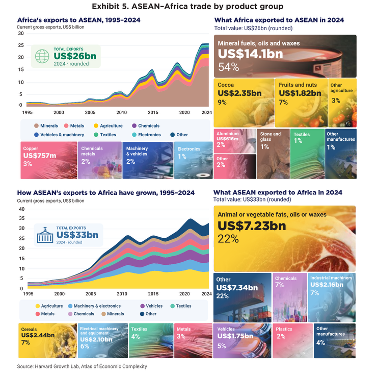
Africa mainly ships mineral fuels, cocoa, cashews, copper and other industrial materials to ASEAN, while ASEAN exports vegetable oils, rice, machinery, vehicles and chemicals to Africa.
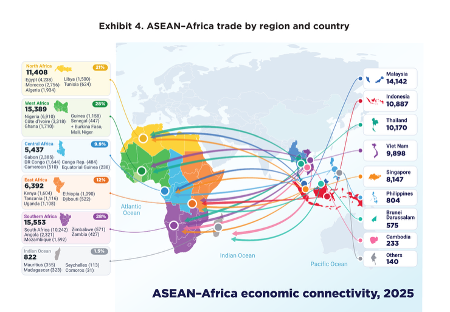
These relationships provide a foundation for growth, although further development will depend on diversification, investment, and connectivity.
From Commodities to Industrial Value Chains
The ASEAN–Africa corridor is gradually evolving beyond traditional merchandise exchanges.
Several commercial relationships illustrate this transition:
- Minerals and manufacturing: South African manganese supplies Malaysian industries.
- Agricultural processing: Ivorian cashews support Vietnam's processing sector.
- Food distribution: Thai rice reaches South African consumers.
- Local manufacturing: Singapore-based Tolaram developed Indomie into a Nigerian manufacturing platform.
Tolaram demonstrates how exports can evolve into local production. After introducing Indomie to Nigeria in 1988, the company expanded into manufacturing, distribution, and supporting industrial activities.
These developments connect with wider manufacturing changes. Read more about this context in Southeast Asia's Supply Chains Reconfigure.
For businesses, the opportunity lies in identifying where processing, production, and distribution can create value across both regions.
Beyond Trade: Investment and New Business Partnerships
ASEAN–Africa cooperation increasingly extends into investment, technology transfer, and long-term operations.
Singapore and Malaysia are established investors in African manufacturing, infrastructure, energy, and services. Meanwhile, African digital financial services and business models are entering Southeast Asian markets.
As Isabelle Aimonetti, Founder and CEO of AG Partners Publicis Africa and President of the CCE Africa Commission, observes:
"The Asia–Africa trend is an iceberg, and today we are talking about its tip."
However, business conditions differ across markets. Companies must assess regulations, distribution capabilities, partners, and financial feasibility.
Reliable market intelligence remains essential. Businesses exploring opportunities can use ASEAN market research and strategic consulting services to evaluate demand, competition, and potential partnerships.
Could ASEAN–Africa Trade Reach US$112 Billion by 2035?
The whitepaper presents three scenarios for economic integration through 2035.
Trade-led continuity assumes growth through established products and trading relationships, with limited structural change.
Selective integration, the central scenario, projects approximately US$112 billion in merchandise trade by 2035, supported by targeted industrial partnerships, investment, and improved market access.
Accelerated integration assumes broader progress across infrastructure, financing, institutions, and cross-regional investment.
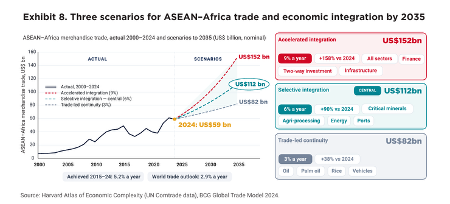
These are scenarios, not guaranteed forecasts. Stronger integration will depend on competitive production, reliable logistics, financing, and sustainable partnerships.
Frequently Asked Questions
How much do ASEAN and Africa trade?
ASEAN–Africa merchandise trade reached approximately US$59 billion in 2024, according to Harvard Atlas of Economic Complexity data cited in the whitepaper. Although trade has expanded substantially since the beginning of the century, it remains a relatively small component of global merchandise exchanges, indicating room for stronger commercial relationships.
Which ASEAN countries trade most with Africa?
Malaysia, Indonesia, Thailand, Vietnam, and Singapore account for almost all ASEAN–Africa merchandise trade. Their commercial relationships cover agriculture, energy, manufacturing, industrial materials, and consumer products. Each country contributes different industrial capabilities, creating opportunities for businesses seeking suppliers, customers, or investment partners across the two regions.
What does Africa export to ASEAN?
Africa primarily exports mineral fuels, agricultural commodities, and industrial inputs. Important products include cocoa, cashews, copper, and other metals used in manufacturing. These flows support Southeast Asian processing industries and offer opportunities for industrial cooperation, particularly where African producers can develop additional processing capabilities.
What does ASEAN export to Africa?
ASEAN exports vegetable oils, rice, machinery, vehicles, chemicals, textiles, and manufactured products. Some Southeast Asian companies are moving beyond exports into local manufacturing and distribution, allowing them to serve African customers more directly. Such investments depend on sufficient demand, competitive operating costs, and reliable infrastructure.
How large could ASEAN–Africa trade become by 2035?
The whitepaper's central selective-integration scenario projects approximately US$112 billion in bilateral merchandise trade by 2035. Alternative scenarios reflect different levels of economic integration. Actual outcomes will depend on infrastructure, financing, industrial partnerships, market access, and businesses' ability to establish commercially sustainable cross-regional operations.
Explore the Next ASEAN–Africa Economic Corridor
ASEAN and Africa are developing stronger commercial relationships, with opportunities extending beyond trade toward investment and integrated value chains.
For business leaders and investors, the full whitepaper provides deeper analysis of seven priority value pools, five emerging shifts, and the conditions shaping cooperation through 2035.