
Thailand is sharpening its cultural export playbook by treating identity as an economic asset. A government-led approach is now visible in how agencies promote culture abroad, rather than only regulating it at home. Under former Prime Minister Srettha Thavisin, the National Soft Power Strategy Committee (NSPSC) was created in 2023, with CNN describing a focus on 13 key areas including food, festivals, music, film, fashion, and tourism. TIME also reports the NSPSC laid out 11 focus areas, spanning food, gaming, festivals, music, film, literature, arts, design, sports, fashion, and tourism. This broader framing underpins the topic of Thailand creative economy soft power, where culture and commerce are increasingly planned together.
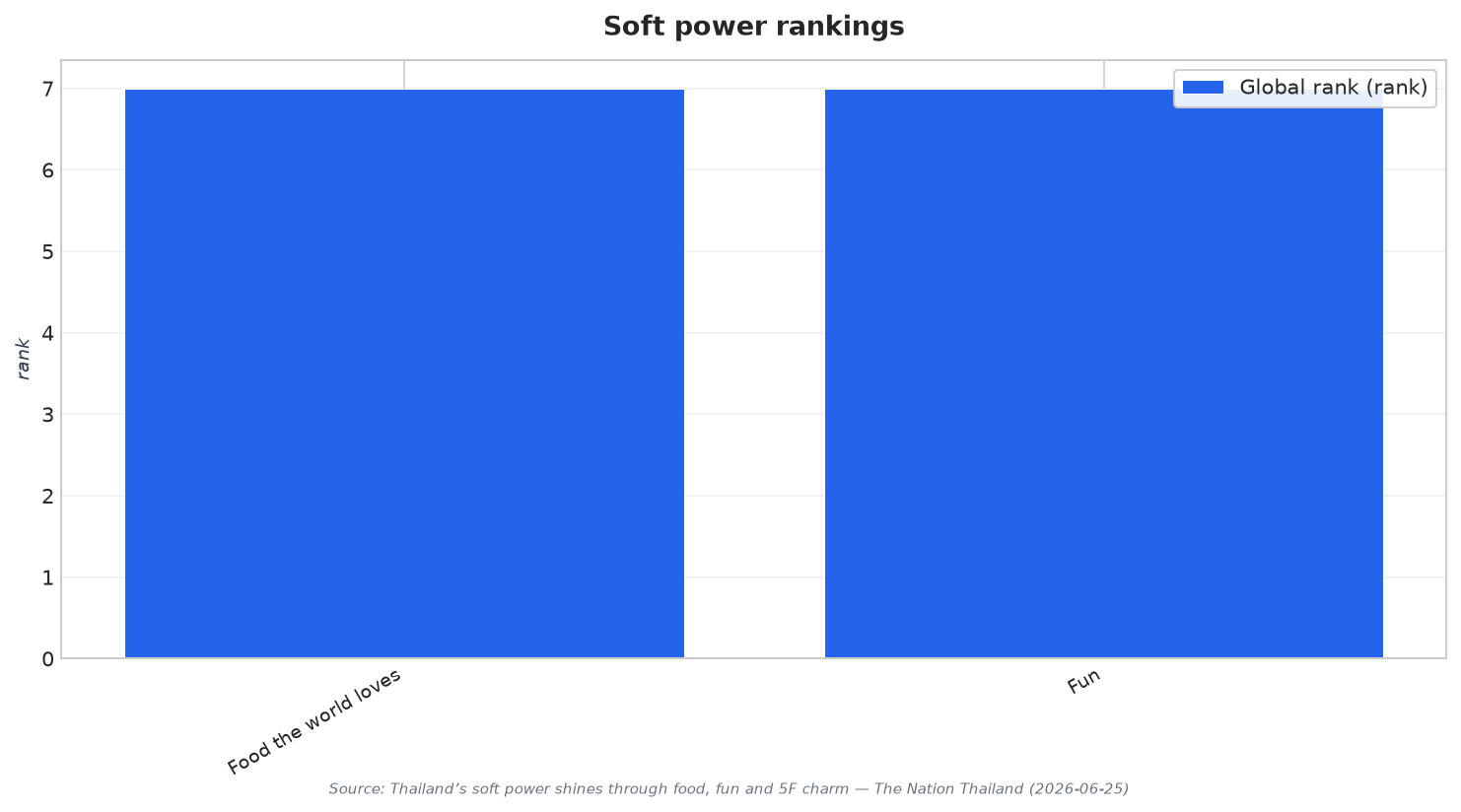
Food remains a flagship, but it is now paired with measurable brand signals. The Nation reports Thailand’s soft power ranking improved to 38th globally in 2026, driven by high global rankings for “food the world loves” (7th) and “fun” (7th). It frames the strategy through the 5F pillars: Food, Film, Fashion, Fighting (Muay Thai), and Festivals, with major events like Songkran and Loy Krathong positioned as global magnets. TIME notes the government supported extending Songkran from three days to a month, reinforcing how festivals can be engineered into longer cultural moments rather than one-off celebrations.
Film, Streaming, and Genre Strategy Turn Local IP Into Exports
Thailand’s film and content industry is also scaling beyond its home market through export-friendly genres, platform distribution, and active promotion. A 2026 industry analysis reports 58 Thai movies were released in 2023, and 10% of Thai films produced that year were released exclusively on streaming platforms. In the same research set, streaming overtook 60% of film distribution, alongside THB 25 billion in total digital entertainment revenue. Genre is a deliberate lever: horror accounted for 40% of Thai films produced annually in one dataset and 45% of local film releases in another. It also contributed 28% of total box office revenue in 2023 and delivered a 25% higher audience retention rate on VOD compared to other genres.
Exporting content also means adapting it. The same film analysis notes Thai films exported to China are usually edited to remove 10–15% of content for censorship compliance. Local hits still anchor the story: Pee Mak is cited as the highest-grossing Thai film of all time with 1 billion THB revenue, while another 2026 statistics roundup reports that “The Undertaker” alone raked in over 700 million THB last year. Inbound work matters too. Thailand hosted 466 foreign film productions in 2023, with 35% of all foreign filming taking place in Bangkok, reinforcing Thailand’s role as both a production base and a screen image.
Series exports and celebrity-led attention add another channel. SCB EIC estimates the Y-series and gender-diversity content industry will be worth more than 4.9 billion baht in 2025, with average annual growth of 17%, and a rising share of Thailand’s total entertainment media production value to 3.9% from 0.7% in 2019. In 2024, Thailand accounted for more than 55% of BL series production in Asia and around 60% of GL series production in the region, amplified through services including Netflix, WeTV, iQIYI, YouTube, and GagaOOLala. The analysis adds that Thai BL series generate over 1 billion views on global streaming platforms, and fan-meeting events can generate up to 10 million THB in ticket sales per event. CNN also points to film tourism effects: “The White Lotus,” filmed on Koh Samui, drove an 88% jump in online searches and a 300% tourism increase to the island.
How is Thailand linking the creative economy to soft power policy?
What film and streaming indicators show Thailand’s content export momentum?
Why is horror a key part of Thailand’s film export strategy?
How big is Thailand’s BL and GL series presence in Asia?
What does Thailand’s soft power ranking suggest about food-led appeal?