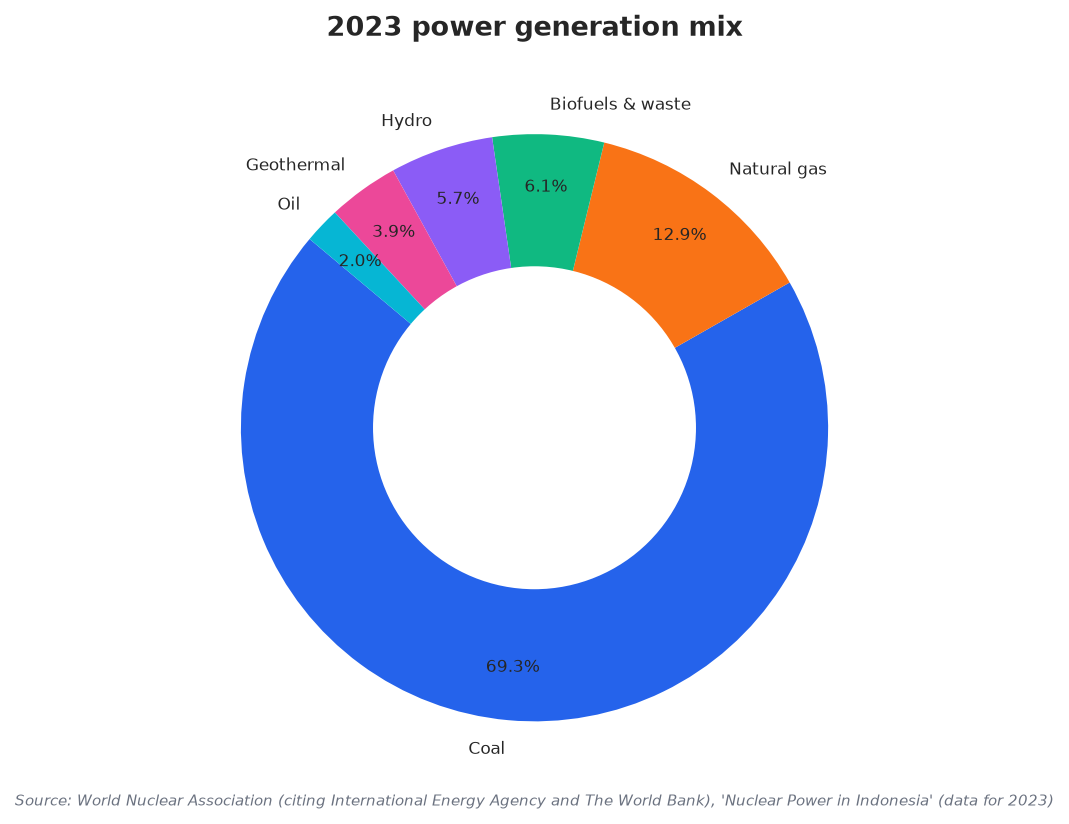
Indonesia’s power system is large, fossil-heavy, and under pressure to grow more reliable as demand rises. In 2023, total electricity generation was 433 TWh, led by coal at 300 TWh (69%) and natural gas at 56.0 TWh (13%). Biofuels and waste added 26.5 TWh (6%), hydro 24.6 TWh (6%), geothermal 16.9 TWh (4%), and oil 8.6 TWh (2%). Nuclear’s contribution remains 0% because the country has no operating nuclear power plants, only research reactors. That gap is what policy makers are now trying to close as blackouts remain frequent, even with electrification reported at about 99.8% as of 2024.
The new momentum comes from formal targets rather than built assets. Under President Prabowo Subianto, nuclear was elevated to a pillar of national energy policy and explicitly written into PLN’s Electricity Supply Business Plan (RUPTL 2025-2034). In September 2025, Indonesia’s revised National Energy Policy (KEN) set an energy-transition pathway to net-zero emissions by 2060 and designated nuclear as part of the national energy mix. The policy targets nuclear at 0.4–0.5% by 2032 and 2.8–3.4% by 2040, before rising further by 2050 and 2060. This is the context for how the Indonesia nuclear power market is being defined: planned shares, grid constraints, and readiness, not generation today.
From Targets to Siting: Why the First Units Are Small
Indonesia’s near-term nuclear planning centers on small units and specific locations. The RUPTL includes proposals for 500 MWe (2×250 MWe) from 2032 in Sumatra/Bangka Belitung and West Kalimantan, and the government has set a 2032 target for the debut reactor. Officials have linked reactor size to grid strength: in Sumatra and Kalimantan, grid strength is about 300 MW per hertz, which is why 250-MW reactor sizes are being studied. As a result, only Java–Madura–Bali can handle very large nuclear plants for now, while bigger reactors elsewhere would need interconnections linking those grids to Java.
Technology options under discussion also reflect a preference for modularity. The Indonesian government has said it would prioritize small modular reactors, and planning has included floating options, including a floating nuclear power plant proposal supplied by Russia and Rosatom’s pitch for an Indonesian floating plant. A U.S.–Indonesia partnership announced in 2023 supports feasibility work on SMRs, but sources stress these are proposals rather than projects under construction. PT ThorCon Power Indonesia has initiated a licensing process for a plant based on advanced molten salt reactor technology, and a site at Kelasa island in Central Bangka is being investigated to host the plant. Even so, the World Nuclear Association notes Indonesia has made little progress toward its 2032 target for 500 MWe.
Planning for 2040 is as much about institutions and the back end as it is about reactors. Indonesia’s independent regulator is BAPETEN, which licenses, inspects, and enforces nuclear and radiation safety. For waste, Indonesia centralizes radioactive waste at PTLR in Serpong under BRIN, treating and storing low- and intermediate-level waste and keeping interim storage for used fuel from research reactors. Separate research modeling highlights how aggressive scale-ups create dilemmas: one scenario describes an initial 7 GWe deployment by 2040 followed by scaling to 35 GWe by 2060, and it identifies a “Fabrication Sovereignty Gap” with over 90% import reliance as well as a “Backend Reality Gap” in spent-fuel planning. These readiness issues will shape how nuclear can actually show up in the 2040 power mix targets.
Does Indonesia generate electricity from nuclear power today?
What nuclear share does Indonesia target for 2040 in the national energy mix?
What is Indonesia’s first grid-connected nuclear proposal in PLN’s plan?
Why are 250-MW reactor sizes being studied for Sumatra and Kalimantan?
What is changing in Indonesia’s nuclear power market outlook toward 2040?