
Across ASEAN, electrifying public transit is being positioned as both a climate response and a practical upgrade for crowded city networks. UNEP says transportation accounts for approximately one-quarter of all energy-related greenhouse gas emissions, and it is also a major cause of urban and regional air pollution. In Southeast Asia, the pressure to expand and improve public transport is clear: ESCAP notes that while the region is home to over 700 million people, only about 30% of Southeast Asians have convenient access to public transport, compared with a global average of 50%. For many city leaders, electric buses are becoming a visible way to pursue cleaner streets while improving daily mobility.
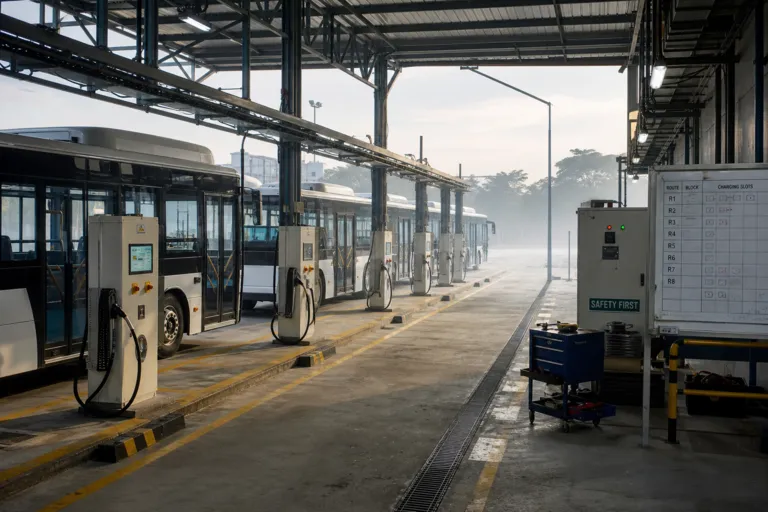
Singapore shows how a structured, long-term plan can anchor confidence in fleet transition. The country is deploying new fully electric buses as part of its sustainable development vision by 2030, within a longer-term goal of electrifying all of Singapore’s 5,800 public buses by 2040, including hybrid buses. The new buses supplied by ST Engineering Mobility Services use overhead pantograph chargers with a maximum output of 450 kW. REGlobal reports a charging time of 30 minutes for a bus with a range of 130 km per charge. Beyond buses, Singapore’s URA and LTA will install 620 EV charging stations in public car parks islandwide, with plans to generate additional solar energy from transportation infrastructure.
What Is Driving, and Slowing, the Switch to Electric Buses?
Policy ambition is rising, but procurement realities still shape deployment speed in many ASEAN cities. MarqStats projects commercial fleets as the fastest-growing end-user segment in ASEAN’s EV ecosystem, with approximately 34.72% CAGR, and describes electric buses as the most commercially advanced and volume-dominant sub-segment because routes are fixed and charging can be centrally managed. Yet the same source flags the biggest friction point: electric buses cost approximately two to three times more than equivalent diesel buses in ASEAN markets. It also cites Indonesia’s Ministry of Transportation noting that less than 10% of Jakarta buses are electric despite incentives, underscoring how budgets and financing can cap progress beyond pilots.
Vietnam’s early rollouts illustrate how operators are moving from diesel and petrol toward electric options, especially in high-pollution urban centers such as Hanoi and Ho Chi Minh City. REGlobal reports that VinBus Ecology Transport Services launched the first smart and fully electric bus, branded “VinBus,” in Vietnam. The first electric bus route commenced commercial operations in Ho Chi Minh City in March 2022: the D4 route spans from Vinhomes Grand Park to Sai Gon Bus Station, with a service frequency of 20 minutes. The same source says VinBus Ecology plans to deploy 150 to 200 electric buses in Phu Quoc, Hanoi, and Ho Chi Minh City, with models featuring battery capacity of up to 281 kWh and a driver behaviour surveillance system designed to alert on potentially dangerous activities.
Outside major capitals, smaller markets are also testing electric bus networks while grappling with system readiness. ESCAP reports that Lao PDR’s Vientiane Sustainable Urban Transport Project launched its first 55 electric buses in a Bus Rapid Transit system trial in June 2025. Across the region, planners are learning that charging is not an “add-on.” MarqStats warns that deploying electric buses without dedicated depot charging—including grid upgrades, charging management software, and operational scheduling systems—can create operational failures that discredit programmes. For ASEAN electric bus transport, the near-term winners are likely to be cities that match vehicle specs, routes, and charging windows with disciplined procurement and depot planning.
Why are ASEAN cities prioritizing electric buses in public transport plans?
What is Singapore’s timeline for electrifying its public bus fleet?
What charging specs are reported for Singapore’s new electric buses?
How much more do electric buses cost than diesel buses in ASEAN markets?
What does ASEAN electric bus transport need beyond buying vehicles?