Thailand’s EV transition is being shaped by policy that links incentives to industrial localisation. MarqStats describes Thailand as an “incentives-to-industry” archetype, where rapid registration growth in 2022–2024 occurred alongside policy packages that tie sales incentives to local production and supply-chain localisation. Verified administrative data from the Department of Land Transport shows ZEV passenger car and pickup registrations rising from 1,958 units in 2021 to 70,582 in 2024, with market share increasing from 0.25% to 10.87% even as the overall passenger car and pickup market contracted sharply. MarqStats also reports BEV registrations in 2025 rose approximately 53% year-on-year to around 147,500 units, signalling continued momentum beyond 2024.
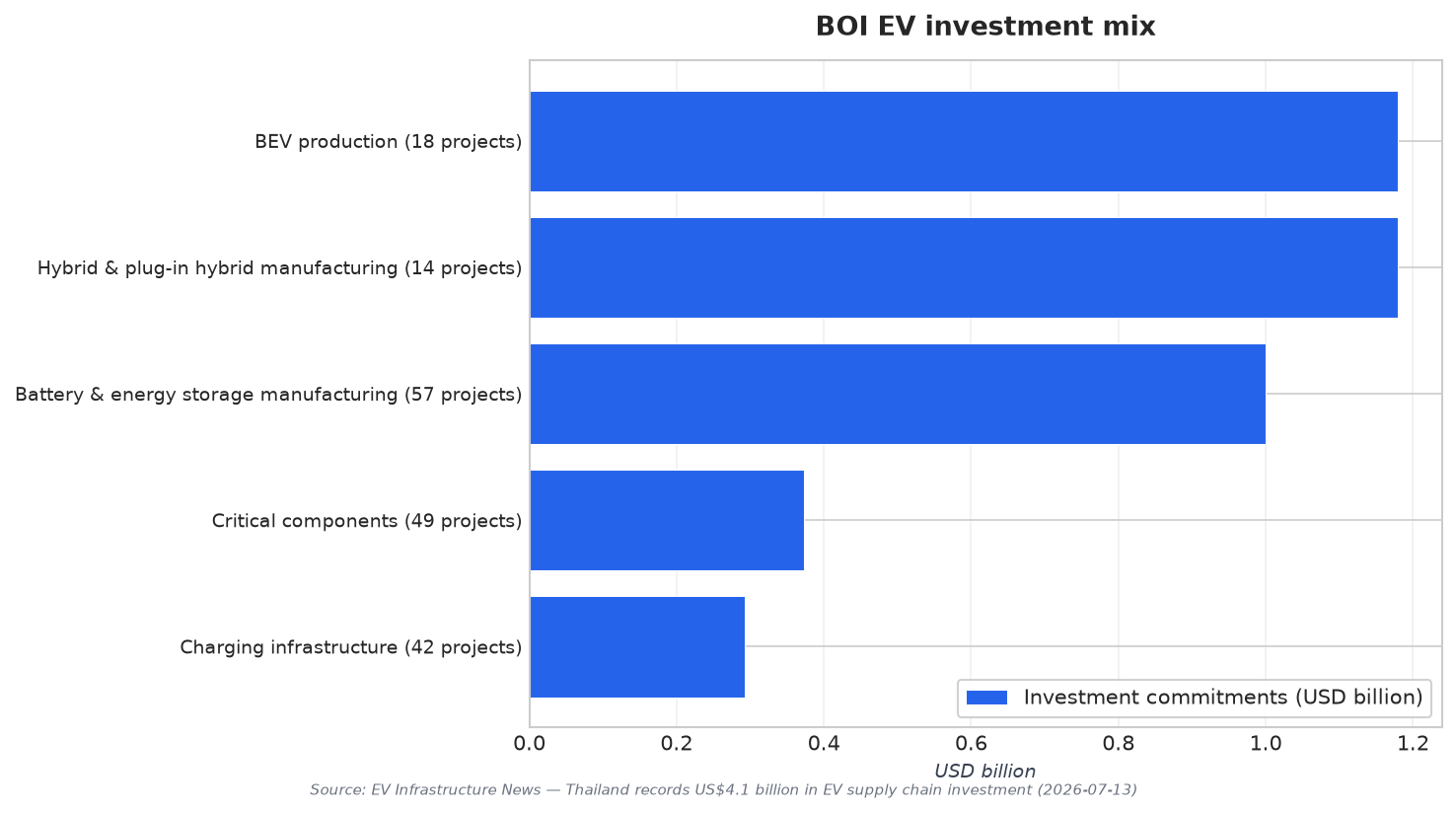
That demand-side story matters because the BOI’s latest investment tally emphasizes the supply chain buildout behind it. According to BOI data reported by EV Infrastructure News, Thailand has secured over US$4.1 billion in EV supply chain investment commitments across 198 projects. The pipeline spans vehicle production, battery manufacturing, components, and charging infrastructure. In this breakdown, BEV production accounts for US$1.18 billion across 18 projects, targeting an annual domestic output capacity of over 370,000 units. Hybrid and plug-in hybrid vehicle manufacturing adds a combined US$1.18 billion across 14 projects, built largely on the existing production infrastructure of Japanese automakers with long-established Thai operations.
EV 3.5 Turns Incentives Into Local Manufacturing Obligations
The EV 3.0 and EV 3.5 packages are framed as industrial mechanisms rather than simple subsidies. MarqStats states these policies link tax reductions and import duty cuts to production obligations. BOI communications echo the same “builder” logic. At iEVTech in Bangkok, BOI Secretary General Narit Therdsteerasukdi said Thailand must choose “to be builders, not just consumers,” and emphasized support for hybrid, plug-in hybrid, and battery electric technologies. That breadth is also reflected in the BOI’s approvals, which EV Infrastructure News says cover the full spectrum of powertrain technologies, deliberately departing from policies in some competing markets that focus exclusively on BEVs.
Battery-related projects are central to the localisation goal. EV Infrastructure News reports battery and energy storage system manufacturing represents US$1 billion across 57 projects, aimed at localising cell and pack production rather than relying on imports. Critical components, including drive motors, battery management systems, and power control units, account for US$373 million across 49 projects. Charging infrastructure investment totals US$292 million across 42 projects, supporting more than 22,900 charging stations nationwide, including more than 10,000 high-speed DC fast chargers. These figures set the context for Thailand EV Battery Investment conversations, because the policy is not only about assembly lines, but also about anchoring higher-value parts of the ecosystem.
The BOI is also using supplier development to translate pledged capital into local procurement. EV Infrastructure News reports the BOI ran 18 supplier matchmaking events over the past two years, pairing more than 800 qualifying domestic manufacturers with multinational automakers and generating over 1,200 business matches. The BOI estimates the sourcing links created through these events will generate over US$1.79 billion in domestic procurement value, as tier-1 and tier-2 suppliers transition into EV component production. Separately, Malay Mail reports that in 2025, electrified vehicles accounted for over 40% of all new vehicle registrations in Thailand, with HEVs at 21.8% and BEVs at 19.6%, reinforcing why BOI-backed localisation is being pushed alongside adoption.
How much EV supply chain investment has Thailand secured under BOI data?
What BEV production capacity is being targeted from approved projects?
What does the battery and energy storage pipeline look like for Thailand EV battery investment?
How large is the charging infrastructure buildout tied to this investment wave?
What evidence is there that EV adoption is growing alongside localisation policy?