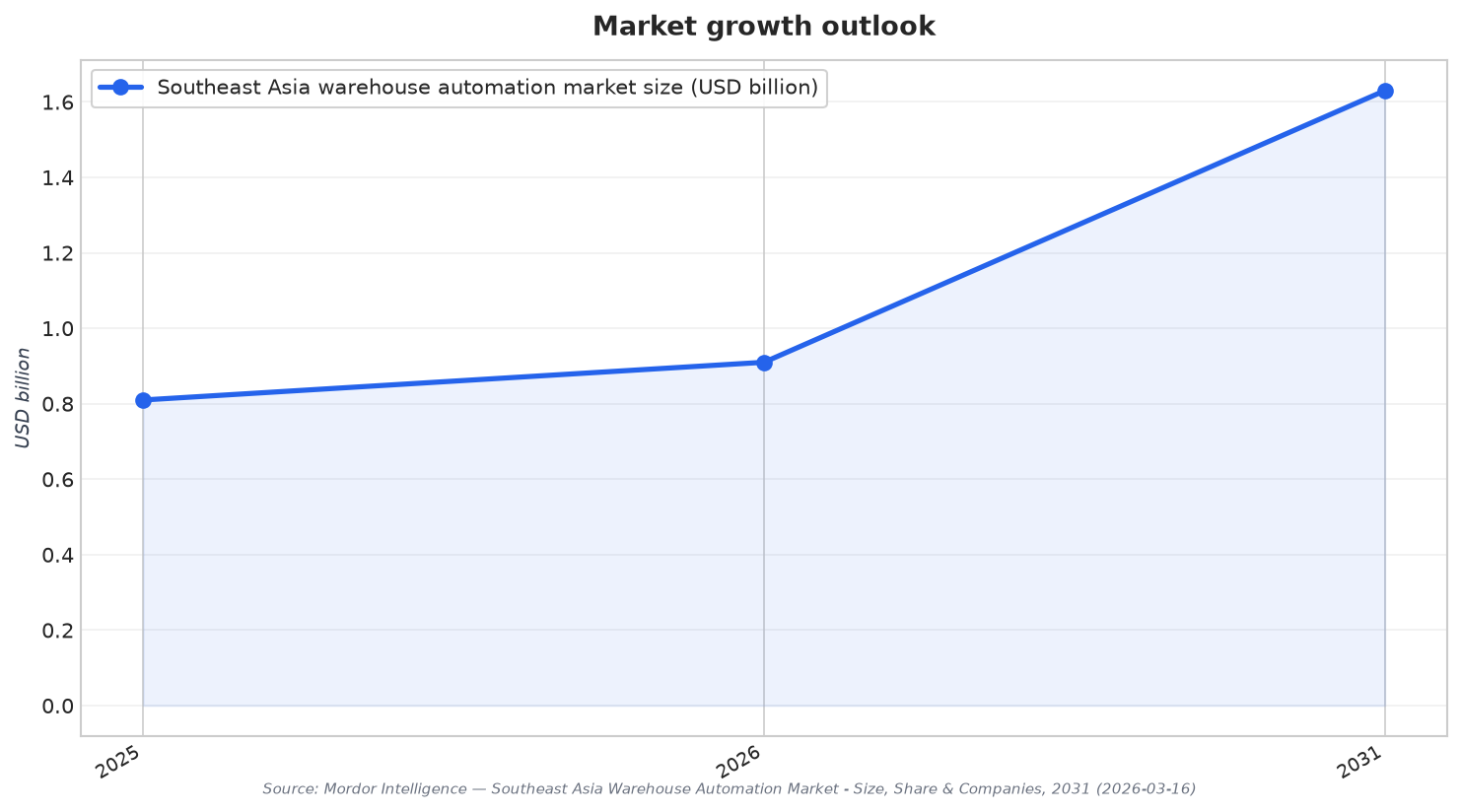
Fulfillment in Southeast Asia is being rebuilt around machines that move, sort, and pick faster than manual workflows can sustain. In one widely cited forecast, the Southeast Asia warehouse automation market was valued at around USD 0.87 billion in 2025 and is projected to reach USD 1.95 billion by 2032, implying an estimated 12.24% CAGR for 2026–2032. Another estimate values the market at USD 0.81 billion in 2025 and sees it reaching USD 1.63 billion by 2031 at a 12.36% CAGR (2026–2031). The direction is consistent: higher throughput requirements and tighter delivery windows are pushing operators toward automation that scales.
Country dynamics matter because warehouse networks in the region are not uniform. One source puts Indonesia at about 30% share of the Southeast Asia warehouse automation market in 2025, while another estimates Indonesia’s 2025 revenue share at 28.63%. Vietnam is flagged as a growth engine too, projected at a 13% CAGR through 2031 in that second forecast. Cost and land constraints also shape adoption choices. Singapore is described as accelerating autonomous mobile robot (AMR) programs, with median warehouse-operative wages above SGD 3,000 (USD 2,250) per month, and it is also cited as having robot density of 818 robots per 10,000 employees in 2024.
Which Systems Are Winning Inside the Warehouse
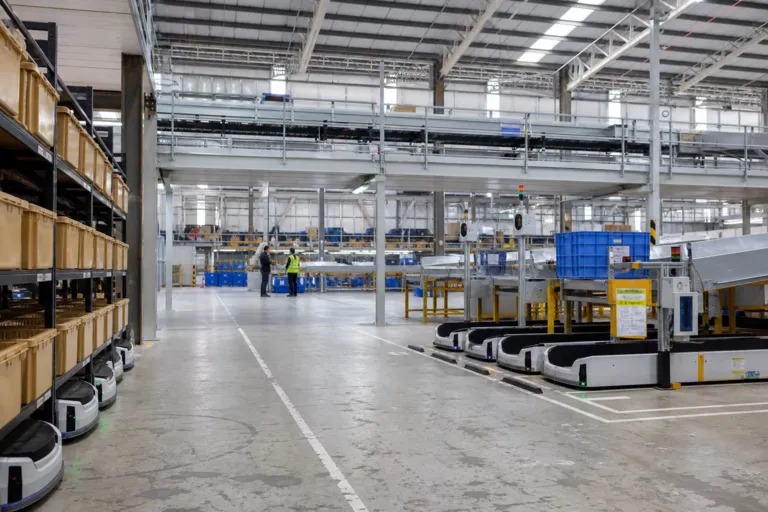
The fastest path to measurable change often starts with core movement and sorting tasks. In one 2025 segmentation of Southeast Asia, conveyor and sortation systems represented about 28% share by automation type. In another 2025 cut of the same regional market, mobile robots commanded 29.76% share and are projected to expand at a 13.92% CAGR through 2031. In e-commerce fulfillment robots globally, order picking is identified as the largest application at 35.8% market share, followed by packing at 21.3%, sorting at 18.6%, and transportation at 16.3%. Those shares align with what warehouses feel daily: picking and packing are the most time-critical labor sinks, so automation is being aimed squarely at them.
End-user segments show who is buying first and at what scale. Logistics service providers (3PL/4PL) are credited with about 32% share in Southeast Asia in 2025 in one report, while another puts third-party logistics providers at 46.51% share by ownership type in 2025. Retail and e-commerce also show strong pull, with 34.14% revenue share in 2025 in that second forecast. Facility profiles add more texture: medium facilities of 50,000–100,000 ft² captured 42.32% share in 2025, and ambient warehouses controlled 71.84% share by temperature zone. Cold-chain facilities are projected to accelerate at a 13.18% CAGR through 2031, reflecting where the next wave of difficult-to-staff operations may modernize.
The near-term story is not only about machines, but also about policy and capability-building that makes deployments easier. Singapore’s Budget 2024 allocated approximately USD 44 million to the National Robotics Program to help translate robotics R&D into real-world applications, including logistics. Malaysia’s investment performance data cited NIA-aligned approvals totaling USD 30.8 billion in the first nine months of 2025, supporting technology-driven sectors that include digitalization initiatives and logistics infrastructure. Meanwhile, broader demand pressure continues to build: one source notes Southeast Asia’s digital economy reached USD 263 billion in gross merchandise value in 2024, up 15% year on year, and in emerging markets including Southeast Asia, less than 5% of warehouses currently use robots, implying significant headroom as operations look for repeatable productivity gains.
How fast is the Southeast Asia warehouse automation market expected to grow?
Which country leads adoption in the region’s automation market?
Which technologies are taking the biggest share in warehouse deployments?
What parts of fulfillment are robots most associated with?
What is driving Southeast Asia warehouse automation in practical terms?