
Penang’s role in global semiconductor packaging is tied to how the state functions as Malaysia’s technology node. Penang Institute describes Penang as the primary driver of Malaysia’s electrical and electronics (E&E) sector, supported by a dense network of multinational corporations and a significant contribution to national exports. The same outlook frames 2026 as a period of cautiously steady growth, with Penang leveraging deep industrial clustering and a global semiconductor recovery, even as geopolitical conflicts between the US and China remain a factor. This combination matters for packaging because packaging and testing sit close to export logistics, supplier ecosystems, and engineering depth, all of which are core to Penang’s positioning.
Penang’s export footprint helps explain why global companies keep building packaging and test capacity there. Seasia.co reports that in 2019, Penang accounted for 5% of global semiconductor exports. It also notes that between 2014 and 2019, Penang’s E&E exports rose by an average of 12% annually, reaching RM210 billion (US$51 billion). Over the same period, exports of professional, scientific, and control instruments grew by an average of 15% per year, reaching RM23 billion (US$6 billion) in 2019. Since 2014, those two sectors contributed 77–82% of Penang’s total annual exports and accounted for as much as 50% of Malaysia’s exports in the same categories, reinforcing why Penang is viewed as a major backend manufacturing base.
Why Packaging Growth Is Pulling Penang Deeper Into the Supply Chain
The global market context makes the stakes clearer for Malaysia semiconductor packaging investment decisions that flow into hubs like Penang. Grand View Research estimates the global semiconductor packaging market size at USD 39,585.2 million in 2024 and projects it will reach USD 70,896.4 billion by 2030, with a CAGR of 10.4% from 2025 to 2030. Other forecasts also point to rapid growth: Mordor Intelligence places the semiconductor packaging market at USD 103.08 billion in 2026 and expects it to reach USD 156.41 billion by 2031 at a CAGR of 8.70%. While these are global figures, they set the competitive backdrop in which Penang’s ecosystem and capacity expansions become strategically important.
Capacity moves in Penang show how global OSAT and packaging services demand is translating into on-the-ground expansion. DataM Intelligence says Asia-Pacific remains the largest and fastest growing region in semiconductor packaging services, and highlights that ASE recently launched its fifth plant in Penang as part of a large expansion that increases its packaging and testing capabilities. That expansion sits inside a services market DataM Intelligence values at US$ 40.4 billion in 2023, rising to US$44.5 billion in 2024, with expectations to reach US$ 107.5 billion by 2033 at a CAGR of 10.3% for 2025–2033. The growth drivers it lists—smartphones, data centers, automotive electronics, and IoT devices—are the same end-markets that intensify the need for advanced assembly and test.

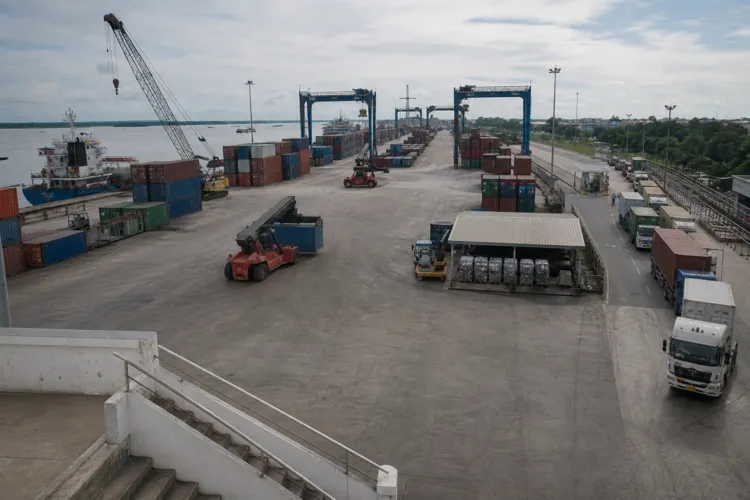
Penang’s ability to keep packaging-linked exports moving also depends on infrastructure and services that surround manufacturing. Penang Institute notes that the state’s freight and logistics sector enables its export-driven economy, with calls to expand air cargo and seaport capacity. It points to the development of a state-owned Penang International Logistics Aeropark (PILA) at Penang International Airport, built to spur logistics through a Free Commercial Zone and complement the zone at the North Butterworth Container Terminal (NBCT). Beyond logistics, Penang Institute adds that global business services (GBS) are becoming a key diversification pillar, leveraging the state’s deep engineering and semiconductor roots toward higher-value functions such as AI-driven analytics, R&D, and IC design. Together, these pieces help explain why Penang is not only producing more, but also trying to move up the value chain.
What shows Penang’s relevance to global semiconductor exports?
How fast did Penang’s E&E exports grow before 2019?
What is a recent sign of packaging and testing expansion in Penang?
How does Malaysia’s semiconductor packaging investment story connect to global market growth?
What infrastructure supports Penang’s export-driven packaging ecosystem?