
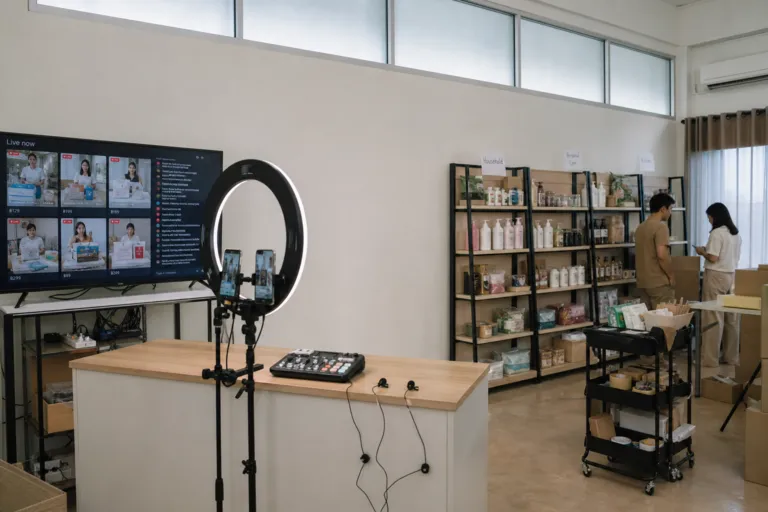
Across ASEAN, e-retail is being pulled forward by formats that look more like entertainment than a storefront. Regional research tracked video and live commerce reaching roughly 25% of Southeast Asia’s e-commerce GMV in 2025, up from less than 5% in 2022. Momentum Works also valued live commerce alone at USD 17.6 billion in 2024, equal to 14% of platform GMV. This shift sits inside a broader market that continues to expand. Google, Temasek & Bain reported the region’s digital-economy GMV at USD 263 billion in 2024, up 15% year on year, and WhiteBox noted it was on track to surpass USD 300 billion in 2025, also up about 15% year on year.
The platform landscape is concentrating, and that matters for how live and social features scale. Momentum Works data compiled by WhiteBox shows the top three platforms—Shopee, TikTok Shop, and Lazada—controlled over 84% of regional GMV in 2024. Shopee alone held about 52% of platform GMV in 2024, up from 48% in 2023. With more than 460 million people using the internet across Southeast Asia—about 80% penetration, per DataReportal figures cited by WhiteBox—these large platforms can push creator-led shopping, ratings, and refunds as default habits. Digital In Asia described the 2024 re-acceleration in Southeast Asia e-commerce as a structural shift driven by shoppable video, live shopping events, and social commerce integration that changed consumer behavior.
Cross-Border Momentum Meets Social-First Shopping
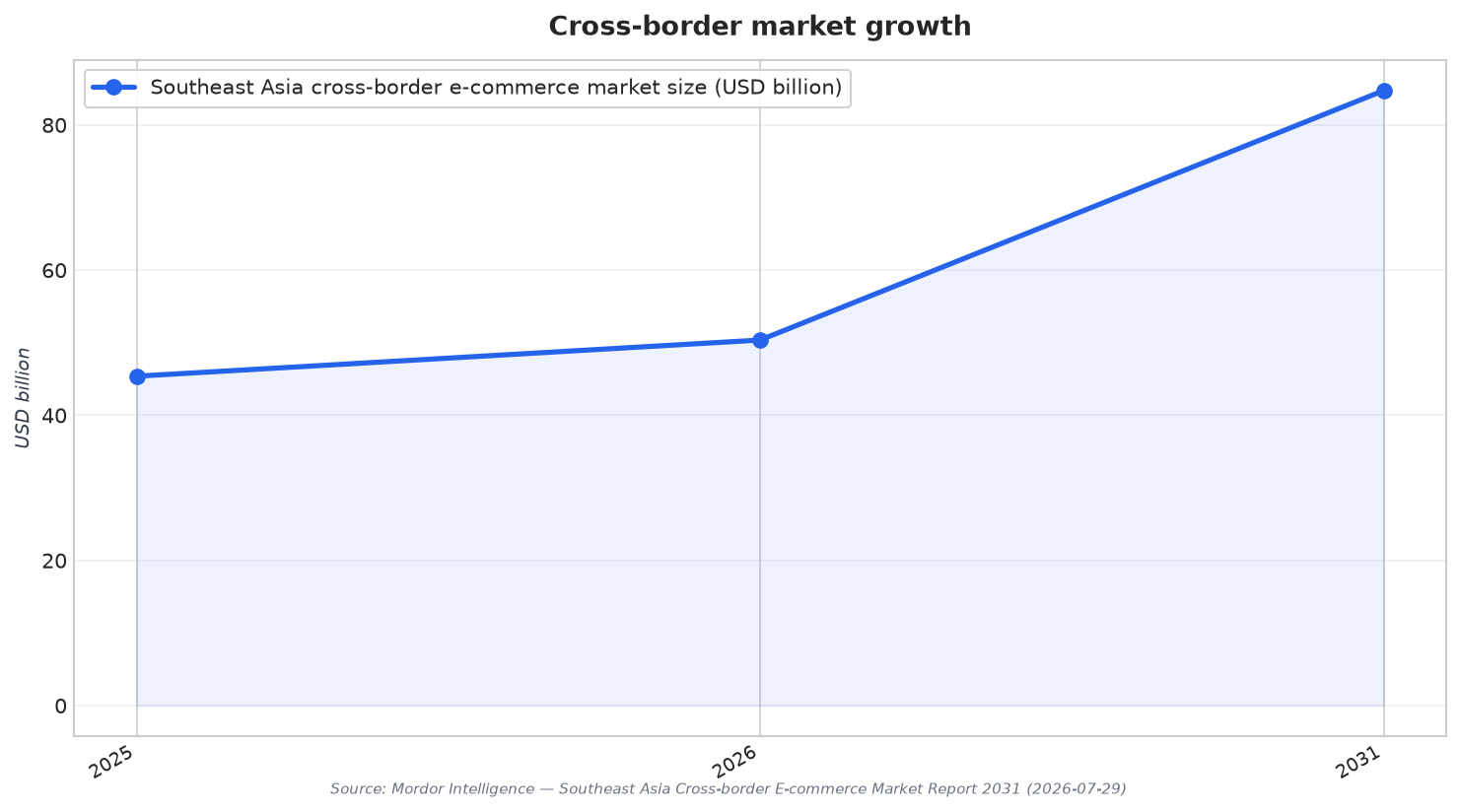
Cross-border demand is rising at the same time, creating more room for social-first discovery to translate into higher-frequency purchases. Mordor Intelligence valued the Southeast Asia cross-border e-commerce market at USD 45.39 billion in 2025 and estimated it would grow to USD 50.37 billion in 2026 and reach USD 84.74 billion by 2031, a 10.97% CAGR from 2026 to 2031. In that same report, online marketplaces held 72.64% of cross-border share in 2025, but social commerce was the fastest-advancing channel with a forecast 19.74% CAGR for 2026–2031. Mordor also reported B2C as 78.12% of cross-border share in 2025, aligning with a consumer-led market where live demos and creator proof can shorten the path from discovery to checkout.
Category dynamics reinforce why live formats matter. Mordor Intelligence reported fashion and apparel leading cross-border revenue share at 29.95% in 2025, while beauty and personal care was forecast to grow at a 10.72% CAGR between 2026 and 2031. AFFiNCO similarly noted that apparel, footwear, and accessories held a 26% market share in 2025 across the region, driven by social commerce and live-stream buying. On the demand side, AFFiNCO stated that about 64% of shoppers check brand social media pages before placing an order, and that fashion, electronics, and beauty make up 58% of all online purchases. These signals match why live selling performs: it is well suited to fit, feel, routines, and rapid comparison shopping.
Payments and logistics are also making social-driven conversion easier, especially for cross-border baskets. Mordor Intelligence reported domestic e-wallet super-apps now power 70% of checkout value in Southeast Asia cross-border e-commerce, helping streamline payments and support higher ticket sizes. The same report said bonded-warehouse logistics supported by ASEAN customs transit protocols are cutting intra-regional delivery times to under three days. Put together, this is the operational layer behind Southeast Asia social commerce growth: engaging video-led discovery on dominant platforms, reinforced by trusted marketplaces, and made repeatable by faster delivery and easier checkout. Indonesia’s weight in the region adds another amplifier, with Momentum Works citing Indonesia at about 44% of regional GMV in 2024, and Mordor estimating Indonesia contributed 34.12% of Southeast Asia cross-border e-commerce revenue in 2025.
What shows that Southeast Asia’s social-commerce-led growth is accelerating?
How concentrated are the main e-commerce platforms in Southeast Asia?
How fast is cross-border social commerce expected to grow in Southeast Asia?
Which cross-border categories stand out, and why do live formats fit them?
What infrastructure is supporting repeat purchases in cross-border e-retail?