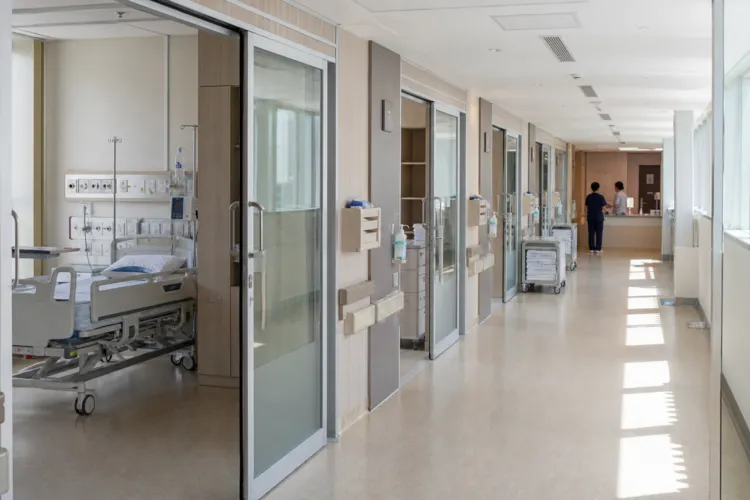
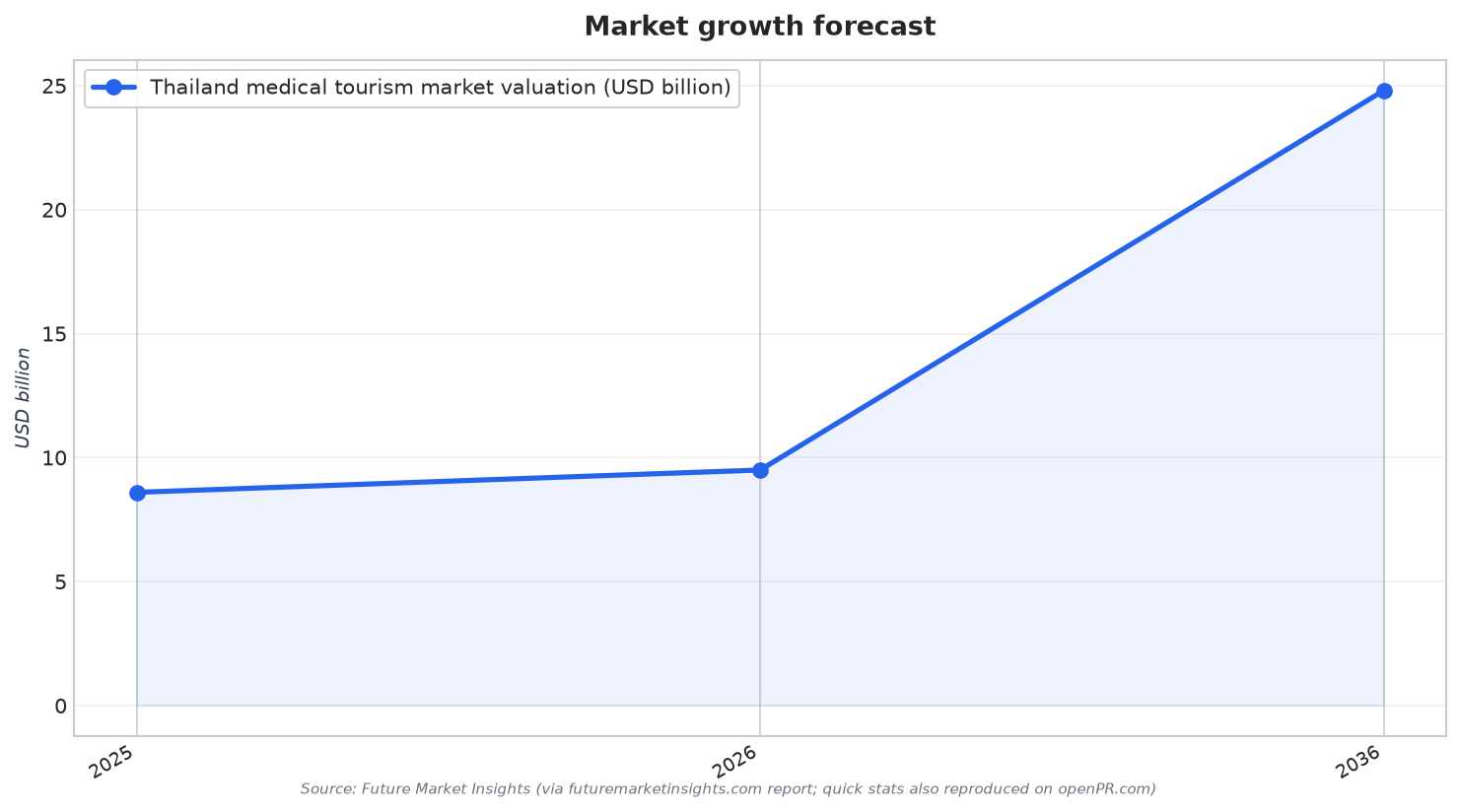
Thailand’s medical travel story is shifting from “affordable procedures” to complex, high-acuity care supported by advanced hospital capabilities. Future Market Insights (FMI) estimates the medical tourism industry in Thailand generated USD 8.6 billion in 2025, rising to USD 9.5 billion in 2026, with a forecast of USD 24.8 billion by 2036. The same outlook reflects a 10.1% CAGR for 2026–2036. In FMI’s framing, growth is increasingly tied to higher-value treatments, including oncology services and robotic-assisted surgeries, rather than volume alone.
Quality signaling and accredited outcomes are also reshaping how international patients choose providers. MarkWide Research describes how Joint Commission International (JCI) accreditation “bifurcates” competition between accredited multi-specialty chains and non-accredited operators, while pointing to private tertiary facilities with English-speaking staff and dedicated international patient centers. FMI adds that the sector’s “flight to quality” shows up in provider performance: BDMS reported an 11% increase in international patient revenue in 2024, driven by higher-complexity cases from Qatar and China. In parallel, analysts cited by FMI in November 2025 expected strong revenue growth from Europe, the Middle East, Myanmar, China, and other markets to mitigate near-term softness from Cambodia.
Where AI Precision Medicine Meets the Wellness Economy
The next phase for the Thailand Medical Tourism Hub is not only about hospital episodes, but also about longer journeys that blend diagnostics, procedures, recovery, and lifestyle. MarkWide highlights robotic surgery adoption, naming Da Vinci surgical systems and similar platforms as expanding procedure complexity, and it notes telemedicine integration as a fast-expanding technology tier. FMI’s strategic takeaways also call for investment in robotic and AI-driven medical technologies. At the same time, Thailand’s wellness travel metrics point to demand for extended stays and repeat visits: TAT-referenced reporting states wellness tourists spend an average of more than 100,000 baht (approximately $3,000) per trip and stay an average of 12 nights, with repeat travel often tied to medically scheduled follow-ups.
Wellness is scaling into a major economic layer that can complement medical travel flows. One report states wellness tourism spending in Thailand more than doubled to 419 billion baht (about $12.7 billion) in 2023. Separately, a Global Wellness Institute figure cited by Nomad Lawyer puts Thailand’s wellness economy at around USD 43 billion in 2024, including USD 14 billion attributed to wellness tourism spending. The same source says the 20th Global Wellness Summit will be held in Phuket from November 10–13, 2026, drawing more than 600 delegates from over 30 countries and targeting a minimum of 300 million baht in direct economic impact, reinforcing Phuket’s role alongside Bangkok in premium health travel narratives.
Underneath the growth story, the market structure is already visible in the segment mix and where care is delivered. FMI estimates cosmetic surgery holds a 25.0% share, while private hospitals account for a 70.0% share, and it identifies Bangkok and Phuket as primary hubs. OpenPR’s summary of the same FMI dataset also cites Bangkok as a top growth hub with a 12.5% CAGR. Yet constraints remain: MarkWide points to physician licensing bottlenecks and warns that over 70% of medical tourist volume flows through a single metropolitan cluster, creating capacity and price pressures. The opportunity, then, is to keep raising clinical value while integrating wellness-led recovery and follow-up experiences.
What is the projected growth outlook for Thailand’s medical tourism market?
How is the Thailand Medical Tourism Hub shifting beyond cost-driven care?
What do the sources say about wellness tourist spending and trip length in Thailand?
Which segments and providers dominate Thailand’s medical tourism market?
What signals growing international demand for Thailand’s higher-complexity care?