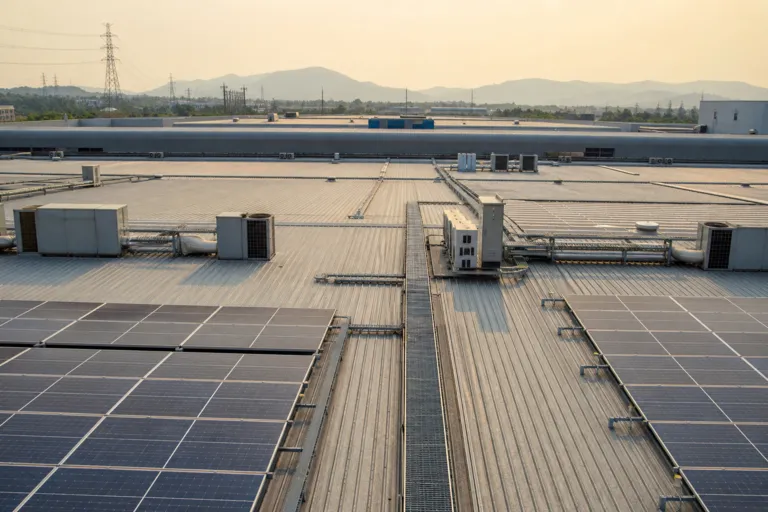
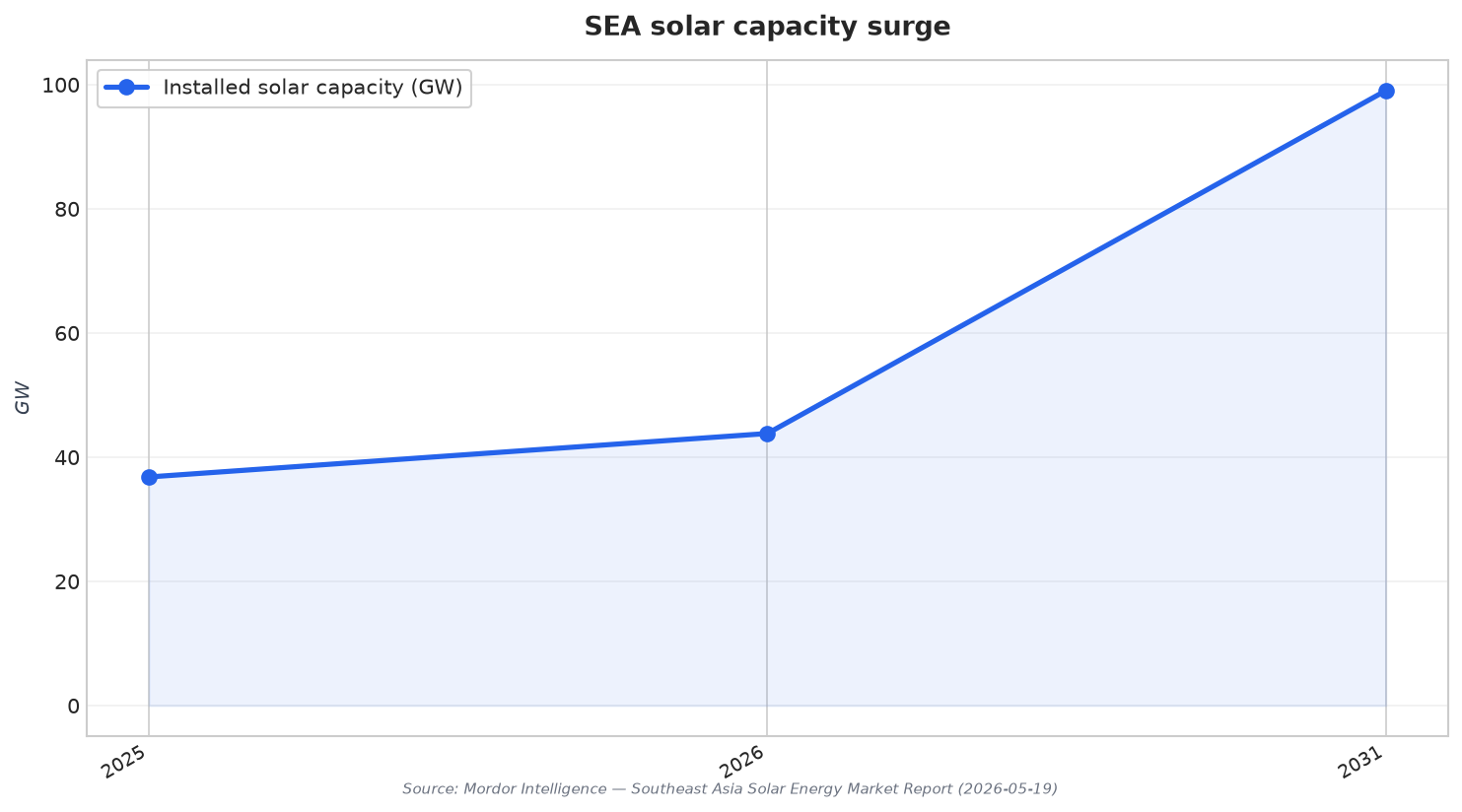
Rooftop solar is moving from a niche sustainability project to an operational energy choice for industry across Southeast Asia. In the wider Southeast Asia solar energy market (all solar segments, not only rooftops), installed base is expected to rise from 36.82 GW in 2025 to 43.82 GW in 2026, and reach 99.04 GW by 2031, with a 17.72% CAGR over 2026–2031, according to Mordor Intelligence. The same report notes on-grid installations held 88.3% share in 2025, showing how strongly grid-connected solar anchors deployment. As retail tariffs rise in Vietnam, Thailand, and Malaysia, Mordor also states that commercial and industrial rooftops can reach grid parity, strengthening the economics for factories and other large power users.
Industry adoption is also tied to procurement and equipment trends that reduce delivered solar costs. Mordor Intelligence links momentum to sharply lower TOPCon module prices, and describes utility-scale suppliers offering 700 W-class modules at USD 0.056 per W. While those figures describe supplier pricing context in Southeast Asia’s broader solar market, they matter to rooftop decision-makers too, because commercial buyers track module and inverter economics closely when evaluating self-consumption projects. Verified Market Research adds that rooftop installations for factories and data centers have surged in Australia and Southeast Asia, supported by high retail electricity prices and “net zero” corporate commitments, contributing to a regional CAGR of approximately 8% to 10% for that segment context.
Why Commercial Rooftops Are Scaling Faster in Industry
Multiple sources point to commercial rooftops—especially large roof formats—as a fast-expanding industrial pathway. MarkWide Research says commercial warehouse and logistics rooftop deployment is hardening as the fastest-expanding vertical across Asia-Pacific. It also notes that Sungrow Power Supply Co. Ltd differentiates through string inverter integration and is described as dominating the power electronics layer for commercial rooftops in Southeast Asia, highlighting how supplier ecosystems are targeting C&I sites. MarkWide further describes typical commercial-module conversion efficiencies ranging from 19% to 23% for silicon-based rooftop PV systems, framing why industrial buyers can generate meaningful on-site electricity even on constrained roof areas, particularly with monocrystalline technology emphasized for space efficiency.
Policy and system design choices are also shaping adoption pace and project structures across the region. Mordor Intelligence states that member states adopted the APAEC 2026–2030 roadmap, lifting the renewables share target to 45% of installed capacity by 2030, supporting offtake certainty for projects that can include distributed and rooftop builds. It also notes Malaysia’s National Energy Transition Roadmap raises the 2050 renewables goal to 70% and mandates that public buildings secure 20% green power within three years, which can indirectly normalize rooftop procurement and contracting. At the same time, Mordor points to constraints—weak distribution grids and cyclone-related insurance premiums—that can temper speed. It also highlights the need for USD 170 billion in region-wide grid and generation capex by 2030, underscoring why grid readiness matters for industrial rooftop interconnections.
For the Southeast Asia rooftop solar market outlook in industry, the near-term story is one of more projects aligning with operational savings, corporate commitments, and grid-connected realities. Mordor Intelligence reports that utility-scale plants led with a 76.6% share of the Southeast Asia solar market size in 2025, which means rooftops are building momentum alongside a still-dominant utility buildout. Still, the same report shows residential rooftops are expected to grow at a 21.9% CAGR between 2026 and 2031, reinforcing that rooftop adoption is accelerating across segments. For industrial players, the practical pathway often centers on grid-tied self-consumption, where installation choices, equipment pricing, and local interconnection conditions determine project viability.
How fast is solar capacity expected to grow in Southeast Asia?
Are most solar systems in Southeast Asia on-grid or off-grid?
What is driving rooftop solar uptake for factories and data centers?
What does the Southeast Asia rooftop solar market mean for industrial rooftops like warehouses?
What rooftop PV module efficiencies are described for commercial systems?