Vietnam’s industrial parks are seeing stronger tenant demand as manufacturers relocate and expand production capacity. One driver is the broader supply chain rebalancing tied to the “China Plus One” strategy, which Vietnam Briefing notes has increased Vietnam’s prominence in global supply chains. By the end of 2025, Vietnam posted 8.02% GDP growth, with growth peaking at 8.46% in Q4/2025, and total GDP estimated at US$514B. Trade momentum also strengthened, with total trade estimated at US$920B, exports up 15.9% year-on-year, and imports up 18% year-on-year. These dynamics are directly linked to higher requirements for industrial land, ready facilities, and logistics access.
FDI flows are reinforcing this momentum and translating into demand for industrial real estate. In 2025, total registered FDI reached US$38.42B, while disbursed FDI hit US$27.62B, rising 9% year-on-year and reaching a 5-year high. Vietnam also recorded 4,054 new projects in 2025, with newly registered capital of US$17.32B. In the same outlook, manufacturing and processing accounted for US$9.8B, or 56.5% of total, while real estate drew US$3.67B, or 21.2%. Major investor origins cited include Singapore at US$4.84B (+27.9%), China at US$3.64B (~21%), and Hong Kong at US$1.73B (+10%).
Occupancy Tightens as Ready-Built Space Becomes the Fast Lane
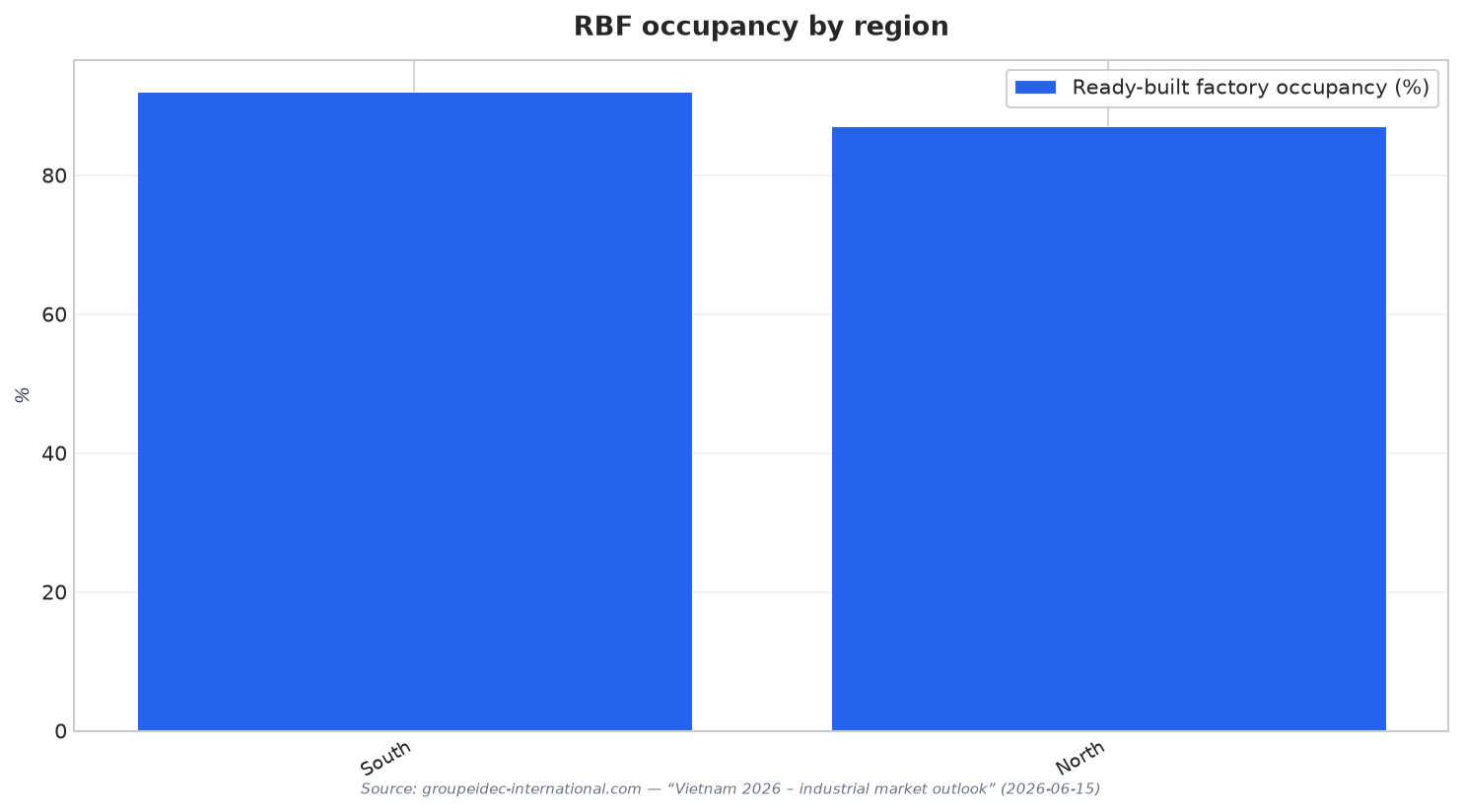
As compliance expectations and speed-to-market pressures rise, ready-built options are taking a larger role in the Vietnam industrial property market. Groupe IDEC’s outlook describes a shift toward Ready-built factories (RBF) and Ready-built warehouses (RBW) to optimize speed-to-market while meeting evolving policies and environmental standards. Occupancy levels indicate why this format matters. Ready-built factory occupancy is about 88% overall, with the South at about 92% and the North at about 87%. Industrial zone occupancy nationwide is estimated at 80–85%. In practical terms, these utilization rates suggest limited slack in established nodes and a need for both new supply and smarter space configurations.
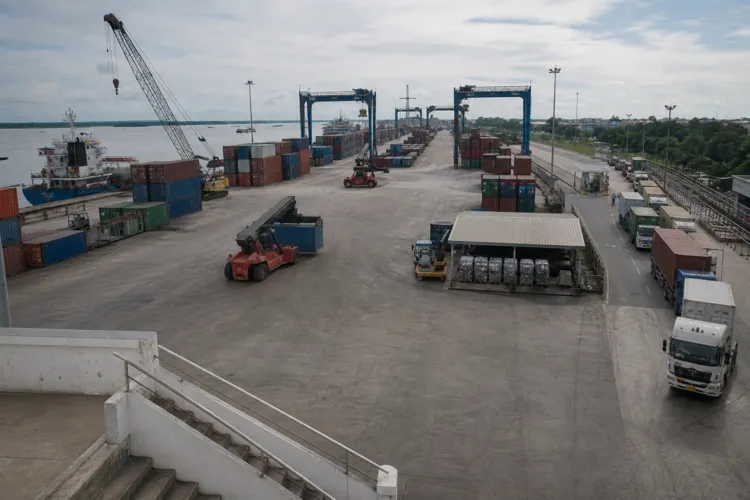
Site selection is also becoming more granular, with connectivity and implementation quality separating high-performing parks from underutilized ones. Nam Dinh Vu highlights how northern provinces around Hanoi and Hai Phong attract investment due to proximity to seaports and improved transport infrastructure, while local authorities work on connectivity and urban planning. Vietnam’s national competitiveness anchors include 34 port zones and 22 active airports, including gateways such as Noi Bai and Tan Son Nhat, plus the future Long Thanh. The same outlook estimates about 17.3–17.5M people employed in industry and construction, which supports large-scale production. Market Business News, citing research on Vietnam, warns that outcomes are not automatic and depend on logistics, tenant demand, infrastructure, workforce availability, and supplier connections.
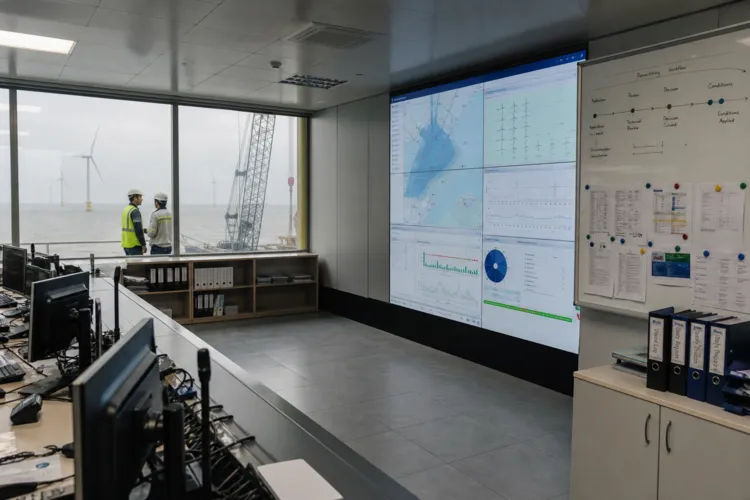
Industrial parks are also being pushed to evolve beyond basic serviced land as tenants raise standards. Observer Post reports that the Vietnam Industrial Park Summit emphasized that the traditional “production space” model no longer meets the needs of global tech giants, calling for ecosystems integrating innovation, green energy, and digital technology. Nam Dinh Vu similarly notes trends toward sustainability, smart technologies such as IoT and data-driven systems, and flexible spaces that let tenants adjust quickly. This evolution is happening as the government targets at least 10% GDP growth in 2026, driven by accelerated infrastructure development including rail, port, and airport upgrades and cross-border connectivity projects. For manufacturers relocating into Vietnam, the competitive advantage increasingly rests on readiness, compliance, and integrated operations—not only on land availability.
What is driving industrial park demand as manufacturers relocate to Vietnam?
How tight is occupancy in ready-built factories and industrial zones?
Which sectors are most tied to the industrial property upswing?
What does the Vietnam industrial property market shift toward ready-built space mean for tenants?
Why are industrial parks being urged to evolve beyond basic production space?