Indonesia’s biodiesel policy is increasingly defining how much crude palm oil (CPO) stays at home versus moves to export channels. Under the Indonesia biodiesel B40 mandate, diesel is blended at 40% palm-based biodiesel and 60% petroleum diesel, and the government began implementing B40 in early 2025. In 2026, officials said the country would maintain B40 while a higher blend is still being studied and tested. This approach matters for palm oil demand because higher mandated blends translate into larger, more predictable offtake for domestic biodiesel producers, tightening the link between policy decisions and CPO utilization.
The scale of B40 is visible in the government’s volume planning and in-market distribution. One report said the government allocated 15.6 billion liters for B40 implementation, and biodiesel distribution from January to November 2025 reached 12 billion liters, or 78% of the full-year allocation. Another report stated that B40 utilization in 2025 required 14.2 billion liters. Together, these figures show an energy-use demand stream that is large enough to influence industrial planning, from feedstock sourcing to logistics and refinery coordination. This is why the mandate has become a central reference point for how Indonesia balances domestic consumption and exports.
B40 Today, B50 Next: Capacity, Levies, and the Supply Push
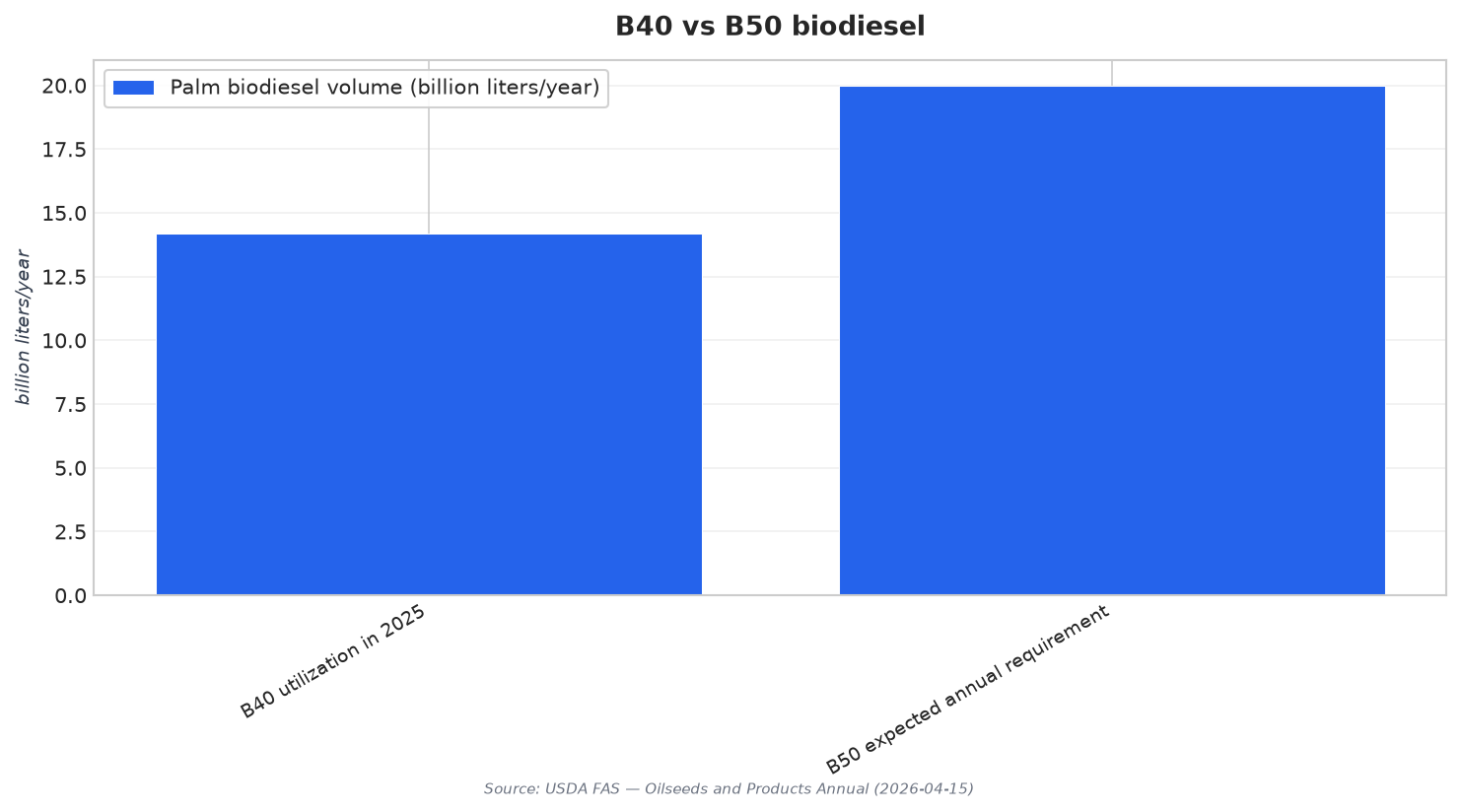
Indonesia’s next step is being designed around B50, but the transition highlights how blending targets can expose capacity and funding constraints. The government planned to start a road test with B50 in December 2025 and targeted the second half of 2026 for nationwide implementation. A USDA report said B50 would require 20 billion liters of palm biodiesel each year, versus 14.2 billion liters for B40 utilization in 2025, and noted that an additional 2–3 billion liters of production capacity will be required to facilitate B50. In early 2026, biodiesel production capacity reached 22 billion liters, up 2 billion liters from the previous year, indicating ongoing investment aligned with policy direction.
Financing mechanisms are also being adjusted alongside blending ambitions. In March 2026, the government increased the crude palm oil export levy by 2.5 percentage points to 12.5%. The same source said the higher levy is expected to generate more than $47 million in additional revenue for the CPO fund, while also risking weaker competitiveness for Indonesian palm exports. This trade-off reinforces the mandate’s domestic pull: supporting biodiesel distribution can require stronger fiscal backing, yet higher export costs can change how producers and traders optimize between domestic sales and overseas demand.
On the palm oil balance itself, USDA revised Indonesia’s 2025/26 palm oil production to 46.7 million metric tons (MMT). For consumption, the same set of reporting projected Indonesia’s palm oil consumption at 22.6 MMT for 2025/26, a 1% increase from 2024/25 on continued biodiesel and food demand, and expected palm oil use for the industrial sector to remain at 14.7 MMT. Industry and media reporting adds context on the policy’s market impact, including commentary that the rollout of blends up to B40 has significantly increased domestic demand for CPO, while B50 planning raises new questions about supply chains such as methanol imports used for FAME production.
What does the Indonesia biodiesel B40 mandate require in fuel blending?
How much biodiesel volume did B40 utilization require in 2025?
How did 2025 biodiesel distribution track against the B40 allocation?
What annual biodiesel volume is expected under B50, and what does that imply for capacity?
What changed in Indonesia’s CPO export levy in March 2026, and why does it matter?