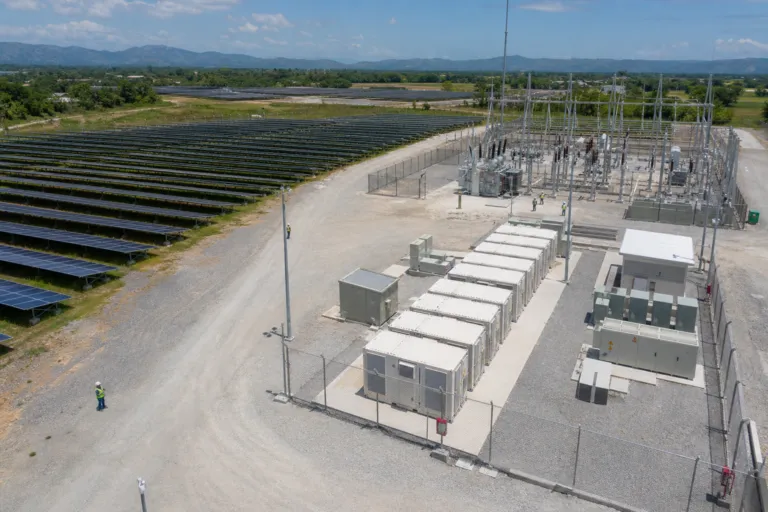
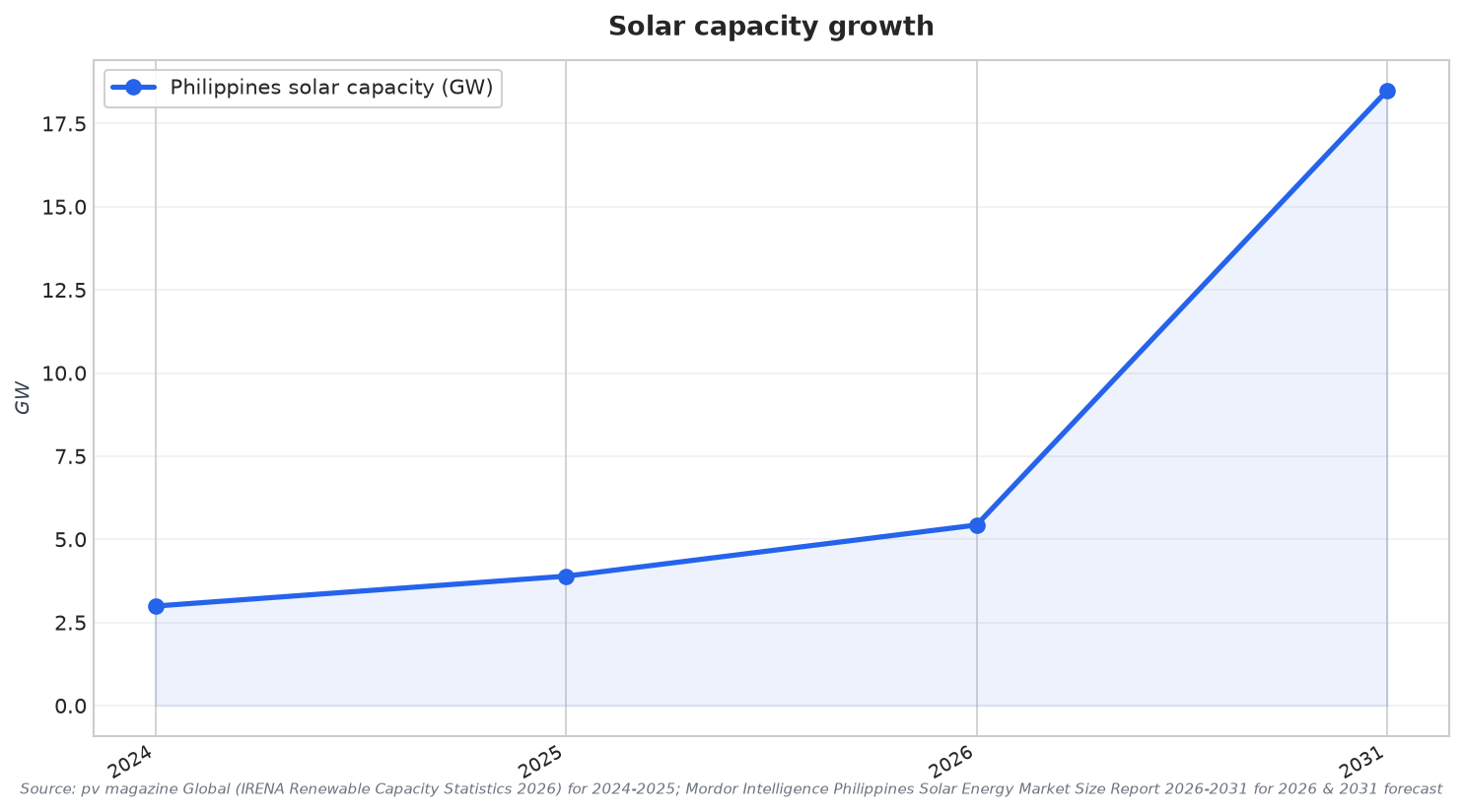
The Philippines is seeing a faster shift toward solar paired with batteries, as auctions, investment approvals, and construction updates converge. IRENA figures cited by pv magazine show the country installed 899 MW of solar in 2025, lifting cumulative solar to 3,892 MW by end-2025 from 2,993 MW a year earlier. The Department of Energy (DOE) also reported a strong tilt toward ground-mounted builds, with 3,492 MW of ground-mounted solar installed by end-2025 versus 52 MW of behind-the-meter capacity. This pipeline matters because hybrid designs are increasingly used to firm output, and developers now treat storage as part of standard project economics rather than an add-on.
Policy signals are reinforcing that shift. Nexdigm notes that in 2026 the DOE updated storage rules requiring intermittent renewable projects of 10 MW or larger to include energy storage equivalent to at least 20% of generating capacity, while encouraging grid-supporting capabilities such as grid-forming inverters. Auction results also show price pressure and scale. Mordor Intelligence reports that the DOE’s third Green Energy Auction awarded 2.5 GW of solar at a record-low PHP 2.45 per kWh, with projects due online by 2027. Separately, pv magazine reports the conclusion of the fourth round of the green energy auction program, allocating over 10 GW of solar, storage, and wind projects, the largest awarded capacity under the program to date.
Gigawatt-Scale Flagships Set a New Benchmark for Hybrid Builds
Several projects illustrate how scale is rising and why this matters for grid planning. Nexdigm highlights the Terra Solar project planned with 3,500 MW of solar PV and 4,500 MWh of battery storage, calling it one of the world’s largest renewable-plus-storage projects. Gulf News also describes the MTerra Solar and Battery Storage Project spanning Nueva Ecija and Bulacan, set to produce 3,500 MW solar with 4,500 MWh battery storage. On the operating side, pv magazine points to the 197 MW Citicore Solar Batangas 1 plus 320 MWh battery energy storage project, described as the country’s first solar baseload power plant. These examples frame how Philippines Solar Storage Projects are evolving from pilot-scale batteries into system-shaping assets.
Construction activity and investment approvals add more evidence that this is becoming the new normal. Gulf News reports that as of June 11, 2026, the Board of Investments certified 13 renewable energy projects worth ₱344.62 billion ($5.63 billion), dominated by solar with grid-scale batteries, hydropower, and wind. It also cites the DOE: 46 renewable energy and related infrastructure projects under construction nationwide valued at $5.9 billion (₱359.64 billion). The same report describes a DOE effort accelerating 22 key power projects equating to roughly 1,471 MW of committed new capacity, including 12 solar projects totaling 1,284 MW, plus other technologies and renewable energy storage systems.
Market outlooks underline why developers are racing to lock in sites, equipment, and interconnection capacity. Mordor Intelligence projects the Philippines solar energy market to grow from 4.25 GW in 2025 to 5.43 GW in 2026, and forecasts 18.49 GW by 2031 at a 27.78% CAGR over 2026–2031. It also says the DOE’s Green Energy Auction Program has awarded 10.2 GW of capacity in its fourth round, pushing the national development pipeline above 36 GW, and names Citicore, ACEN, and Aboitiz Power among major awardees. pv magazine adds that the DOE confirmed plans for GEA-7 to focus on ground-mounted, rooftop, and floating solar systems, alongside a target of procuring an additional 25 GW of renewables under the GEA scheme by 2035.
How fast did solar capacity grow in the Philippines in 2025?
What DOE rule in 2026 increased the role of batteries in new renewables?
Which large Philippines Solar Storage Projects set new scale benchmarks?
What did the third Green Energy Auction reveal about solar pricing?
How big is the current build-out and investment pipeline cited in 2026 reports?