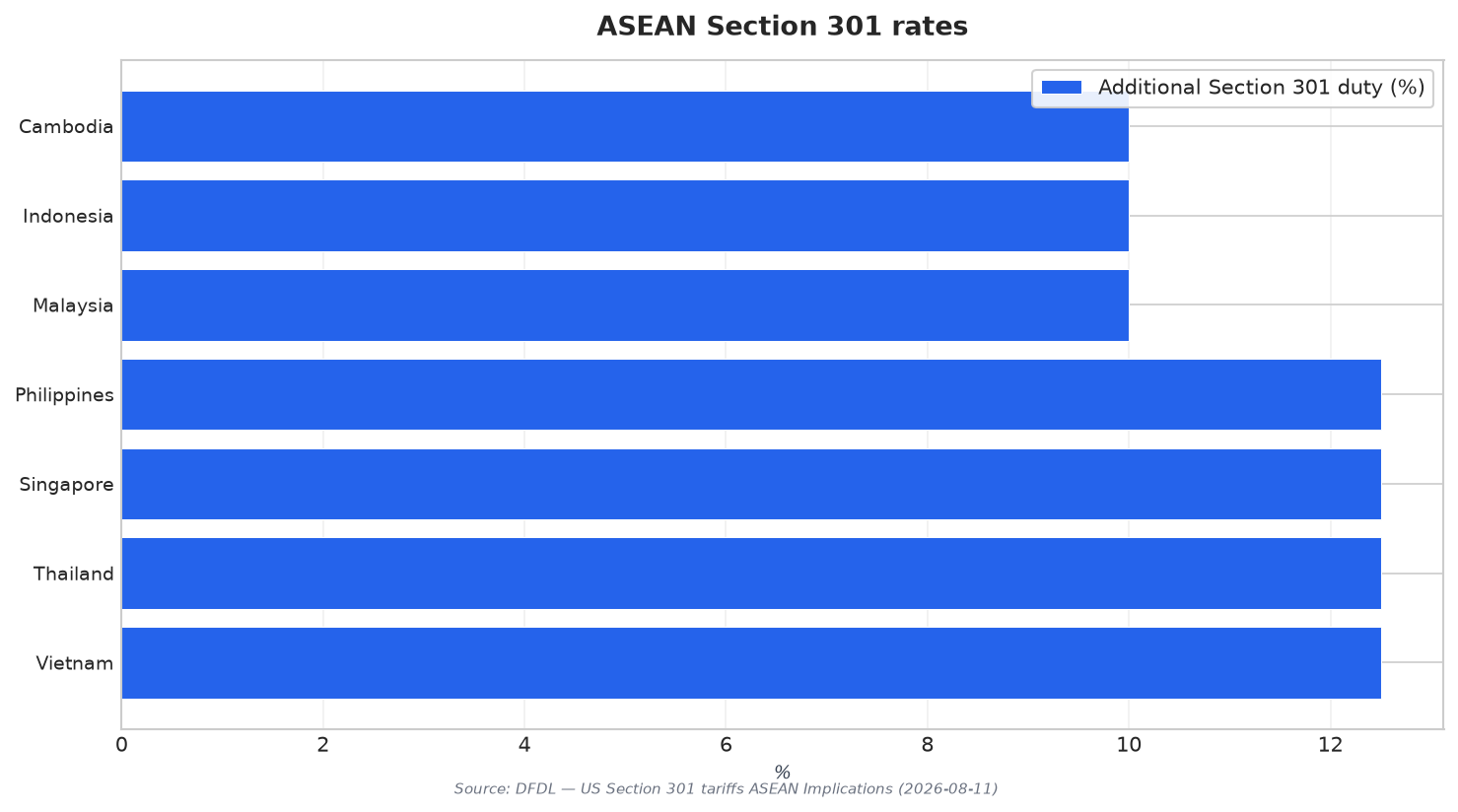
US trade policy toward Southeast Asia changed materially in 2026, and it did not change in a uniform way. After the Administration terminated IEEPA-based additional ad valorem duties in February, Section 232 and Section 301 duties remained in force. Then USTR’s July 23 final action in forced-labor import-policy investigations became the principal new country-level tariff measure affecting ASEAN. For covered merchandise entered on or after July 24, 2026, Cambodia, Indonesia, and Malaysia face an additional 10% Section 301 duty, while the Philippines, Singapore, Thailand, and Vietnam face an additional 12.5% duty. That split is now a key driver of “winners and losers” dynamics in 2026 export planning.
The 10% versus 12.5% structure matters because it is broad but not absolute. USTR identified exemptions, and multiple sources note that certain categories are excluded, including articles already subject to Section 232 tariffs and carve-outs such as energy products, pharmaceuticals, certain electronics, certain aerospace products, semiconductors, and metals used in currency and bullion. For Singapore, the Ministry of Trade and Industry said around one-third of the country’s domestic exports to the US fall within scope, and it would continue engaging the USTR. Malaysia’s Ministry of Investment, Trade and Industry said the USTR had taken account of Malaysian enforcement commitments in setting the rate.
How Supply Chains and Compliance Create Diverging Outcomes
The tariff split lands on top of a broader reshuffle already underway in regional manufacturing footprints. As of May 2026, one analysis put the effective US tariff on Chinese imports at about 33% when stacked across layers including an MFN base rate of about 3.4% and Section 301 rates of 7.5–25% on specific HS codes, among other measures. In the same framing, Southeast Asian nations were described as facing average rates of 10–20%, with significant sector-specific variation. Vietnam, Malaysia, Thailand, and Indonesia were cited as absorbing redirected Chinese manufacturing capacity and greenfield FDI, but also facing risks tied to transshipment penalties, sector tariffs, and oversupply from rerouted exports.
Vietnam shows how enforcement can flip a headline opportunity into a risk-management problem. One supply-chain report cited Vietnam’s 16.4% manufacturing growth in 2023 and projected 15–20% growth in low-carbon tech for 2026, but also described heightened scrutiny. Since July 2025, US Customs has imposed a 40% transshipment penalty on shipments found to have been routed through Vietnam to evade tariffs, with no mitigation or remission available, and the penalty was reissued under CBP HTS code 9903.02.01. The same source said Vietnam accounts for 80% of shipments from Chinese-owned companies to the US (per Exiger supply chain data), making it a focal point for enforcement actions even as it sits in the 12.5% Section 301 tier.
Textiles and apparel are another dividing line, because USTR also directed the establishment, when feasible, of three-year tariff-rate quotas for Bangladesh, Cambodia, Indonesia, and Malaysia. These quotas are designed to permit set volumes of textiles and apparel to enter duty-free, based on each economy’s purchases of US cotton and textile goods, with the 10% rate applying until those quotas are operational. At the same time, exporters across the region face a tighter compliance environment: the former $800 duty-free de minimis exemption remains suspended for commercial shipments regardless of origin, CBP’s new postal informal-entry process took effect July 24, 2026, and a June 3 Executive Order prioritized enforcement involving forced labor, misclassification, undervaluation, and illegal transshipment. For companies mapping ASEAN Section 301 Exposure, the “rate” is only one variable; exemptions, quotas, and enforcement intensity can be just as decisive.
Which ASEAN economies are in the 10% versus 12.5% Section 301 duty tiers in 2026?
What products are excluded from the new Section 301 forced-labor duties?
How large is Singapore’s exposure to the new Section 301 scope?
What does Vietnam’s enforcement risk look like alongside its tariff rate?
How should companies assess ASEAN Section 301 Exposure beyond the headline duty rate?