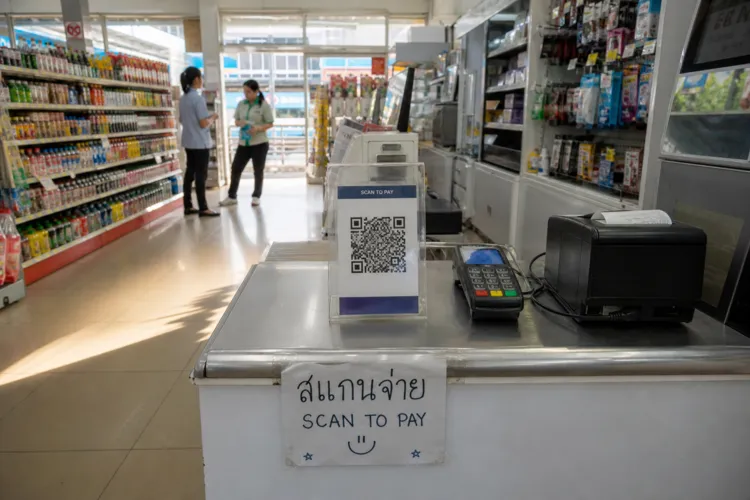

Southeast Asia’s retail payments run on a different playbook than card-led markets. QR codes, e-wallets, and central-bank real-time rails sit at the center of day-to-day commerce, including at street-level merchants. Thailand’s PromptPay has over 90 million registrations and processes more than 74 million transactions daily, according to Bank of Thailand figures cited by Digital in Asia. In Indonesia, the QRIS standard connects 40 million merchants to 57 million users, and it recorded 2.6 billion transactions in a single quarter by early 2025, per Bank Indonesia figures cited in the same source. This is the foundation on which cross-border linkages are now being built.
For merchants and travelers, interoperable QR means a familiar scan-to-pay experience extends beyond domestic borders. One industry source reports that across ASEAN, QR linkages processed over 500 million transactions in 2024, and it links this shift to reducing payment costs by up to 40% compared with card networks. The same source also states that travelers from Thailand, Malaysia, Singapore, and Indonesia made 120 million cross-border QR payments in 2024, described as a 200% jump from 2022. In Indonesia specifically, QRIS linkages with Thailand and Singapore are reported to have seen a 150% rise in tourist payments in 2023. Together, these figures signal rising behavioral comfort with QR across borders, not just within one market.
Why QR Linkage Changes the Economics of Cross-Border Retail
Cross-border QR is not only a consumer convenience story. It is also a settlement and cost story. MarkWide Research notes that Thailand’s Bank of Thailand and the Philippines’ central bank have extended instant payment rails to cross-border corridors, reducing correspondent banking latency from T+2 to near-instantaneous for regional trade settlements. The IMF’s 2026 selected issues paper on Thailand adds that, while still small in value and volume, QR cross-border payments in ASEAN countries have shown a significant surge in growth. It also highlights positive correlations: in each bilateral linkage, cross-border QR payments are positively correlated with tourism receipts, commercial bank transfer fees, and the number of banks participating in the linkage.
These linkages are being formalized through standards and roadmaps. PS Engage describes an early milestone in the PayNow–PromptPay corridor between Singapore and Thailand, calling it the world’s first real-time QR linkage and a model for others. It also states that ASEAN has set a roadmap to build a fully integrated QR ecosystem by 2030, with near-term (2025–26) bilateral expansions planned to Cambodia, Laos, Myanmar, and the Philippines alongside regulatory alignment and infrastructure upgrades. The IMF paper notes that the Philippines has been behind regional peers somewhat in establishing cross-border payment linkages, but it is planning to cooperate with Japan, Malaysia, and Singapore in the coming years.
Looking wider, cross-border QR sits inside a broader Asia-Pacific shift toward wallet-led payments and real-time rails. Mordor Intelligence projects the Asia-Pacific payments market size for digital-wallet transactions will reach USD 21.15 trillion by 2031. It also notes that Malaysia and Thailand exploit geographic positioning to act as payment hubs, connecting ASEAN settlement systems to India and China, and eventually the Middle East. In this context, ASEAN cross-border QR payment connectivity is best understood as practical retail plumbing: it connects national QR systems and instant rails so that small merchants, tourists, and service providers can transact with fewer steps, lower visible friction, and faster settlement.
How fast is cross-border QR usage growing across ASEAN?
What evidence links cross-border QR payments to tourism outcomes?
How do real-time payment rails support QR payment linkages?
What is the ASEAN roadmap for cross-border QR payment connectivity?
What scale do domestic QR systems reach in key ASEAN markets?