
Client
Issues
Vietnam's rapid build-out of solar and wind had outpaced grid capacity in several regions, leading to curtailment and integration challenges.
The utility faced ageing infrastructure, limited real-time visibility of grid conditions, and rising demand from manufacturing and a growing data-centre pipeline.
Balancing decarbonisation targets with reliability and cost created a complex set of trade-offs requiring clear, evidence-based prioritisation.
Solution
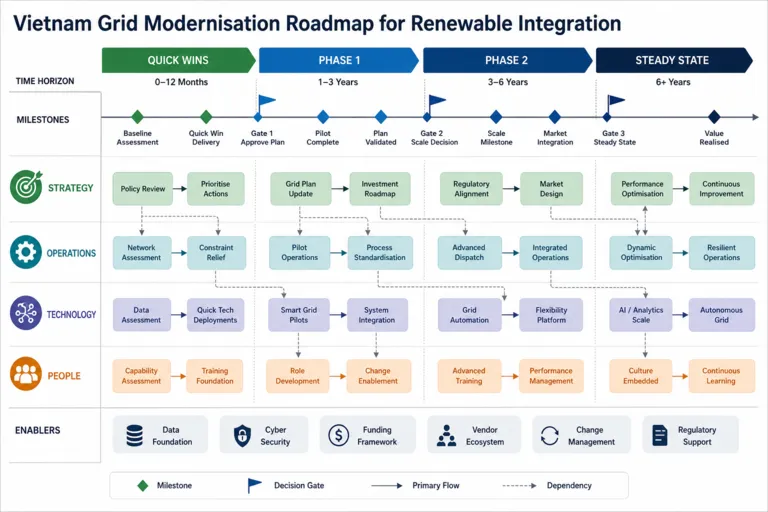
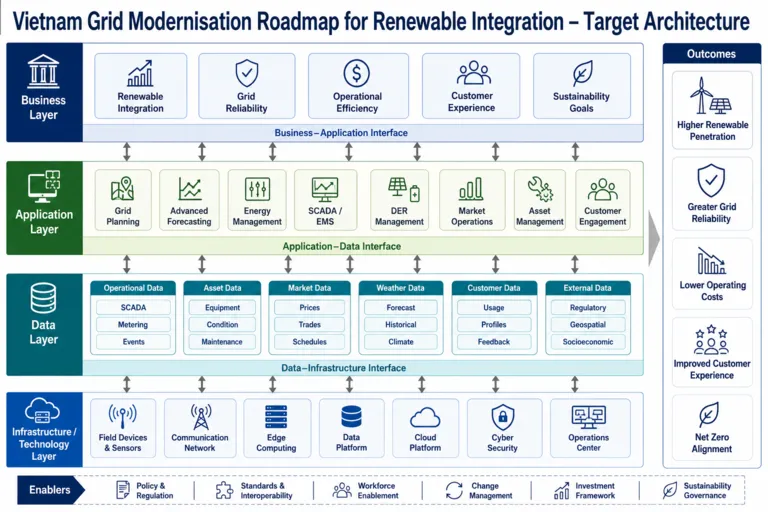
We developed a grid-modernisation roadmap centred on smart-grid technologies, improved forecasting, and targeted investment in transmission and storage.
Our solution prioritised digital monitoring and control systems to improve visibility and flexibility, energy-storage deployment to manage renewable intermittency, and a phased investment plan aligned with demand growth.
The strategy balanced near-term reliability needs with the longer-term transition to a cleaner energy mix.
Approach
The engagement began with an assessment of grid conditions, demand projections, and the renewable pipeline across priority regions.
We modelled demand and integration scenarios to identify where investment would deliver the greatest reliability and decarbonisation benefit.
We worked with the utility's engineering and planning functions to prioritise projects and design a realistic, phased roadmap.
Stakeholder workshops aligned technical, financial, and regulatory considerations, and progress reviews refined the plan as conditions evolved.
Recommendations
We recommended a staged investment programme prioritising smart-grid monitoring, storage in high-curtailment regions, and transmission reinforcement aligned with the renewable pipeline.
We also recommended strengthening demand forecasting and grid-flexibility capabilities, while engaging regulators early on tariff and market-design reforms needed to support integration.
Additionally, we recommended building partnerships with technology and storage providers to accelerate deployment.
Engagement ROI
The modernisation strategy gave the utility a clear, prioritised path to integrate renewables while safeguarding reliability.
Improved forecasting and monitoring capabilities reduced curtailment risk and enhanced grid visibility, while the phased investment plan directed capital toward the highest-impact projects.
The utility strengthened its ability to serve rising industrial and digital-infrastructure demand and positioned itself as a leader in Vietnam's energy transition — supporting a more sustainable, secure, and investable power system.