
Client
Issues
The construction firm faced persistent challenges such as project delays, cost overruns, and communication gaps between stakeholders spread across multiple islands.
Traditional construction practices relied heavily on paper-based processes and manual oversight, making it difficult to track progress in real time.
Additionally, the firm was under pressure to improve safety standards and adapt to a shortage of skilled labour by increasing productivity through technology.
Solution
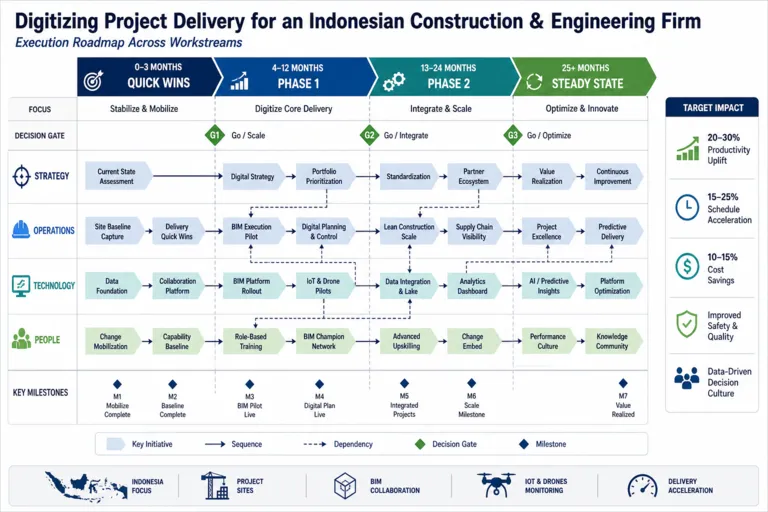
We designed a comprehensive digital transformation roadmap for the company's construction projects.
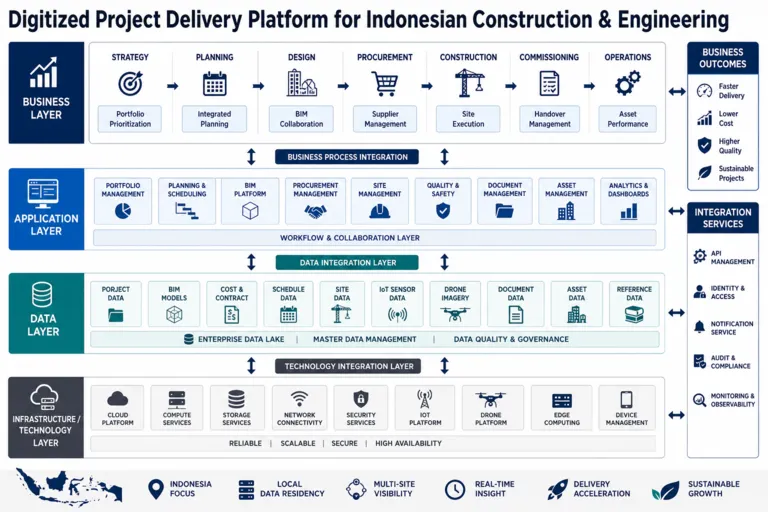
Central to our solution was the implementation of Building Information Modeling (BIM) and project management software to enable real-time collaboration among architects, engineers, and contractors across dispersed project sites.
The strategy also involved introducing drone surveys and IoT sensors on construction sites to monitor progress and equipment health.
By integrating these technologies, the firm could proactively identify potential delays or issues and optimise resource allocation.
Approach
The project kicked off with a detailed assessment of the firm's existing workflows and technology readiness.
We then piloted the new digital tools on a high-profile infrastructure project to demonstrate their benefits.
Training programmes were conducted for project managers and site supervisors on using BIM and data analytics for decision-making.
We facilitated workshops between the IT department and construction teams to ensure smooth integration of new systems with minimal disruption to ongoing projects.
Regular progress reviews allowed for iterative improvements to the digital tools and processes.
Recommendations
To sustain momentum, we recommended establishing a dedicated digital innovation team within the firm.
We also recommended that this team continuously explore emerging construction technologies such as AI for predictive maintenance and AR/VR for design visualisation.
Additionally, we recommended developing strategic partnerships with technology start-ups and universities to stay at the forefront of construction technology.
We also highlighted the importance of updating company policies to encourage data-driven decision-making and investing in ongoing training so staff remain proficient with the latest tools.
Engagement ROI
The digitisation initiative led to measurable improvements in the firm's project delivery and performance.
Pilot projects using BIM and real-time monitoring were completed around 20% faster on average, with significant reductions in material waste and rework.
The company reported enhanced safety records due to better monitoring and predictive maintenance of equipment.
Client satisfaction increased as projects hit milestones more reliably and transparently.
Ultimately, the construction firm strengthened its reputation as an industry innovator, positioning itself to win more contracts in Indonesia's fast-evolving infrastructure landscape.