
Client
Issues
Rapid growth had outpaced the company's fulfilment network, leading to inconsistent delivery times and rising last-mile costs.
Warehousing and inventory were poorly aligned with demand across markets, creating both stockouts and excess.
Cross-border shipments faced customs delays and complexity, and limited real-time visibility made it hard to manage exceptions and customer expectations.
Solution
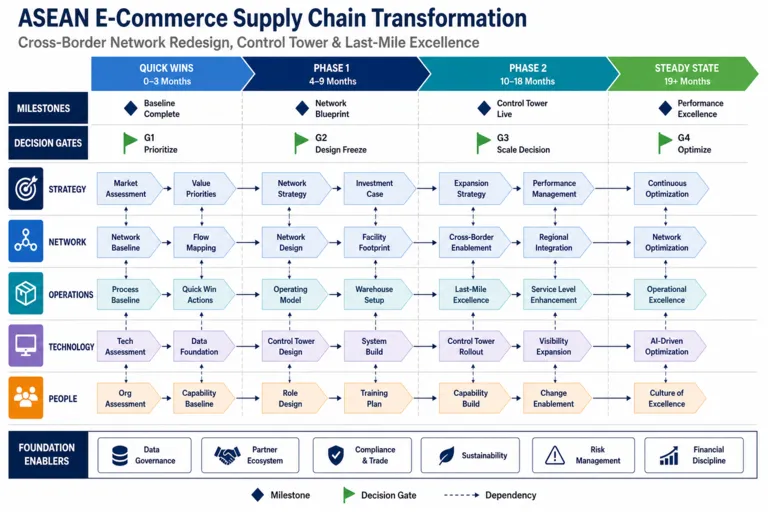
We designed an integrated supply-chain transformation combining network redesign, technology, and process improvement.
Our solution optimised warehouse locations to serve demand closer to customers, introduced demand-forecasting and inventory-optimisation tools, and deployed real-time tracking and control-tower visibility across the network.
Last-mile strategies were tailored to each market — balancing in-house fleets, third-party partners, and pick-up networks — while cross-border flows were streamlined to reduce customs friction.
Approach
The engagement began with a diagnostic of the company's network, cost structure, and technology landscape across markets.
We modelled network scenarios to identify the optimal footprint and inventory strategy, then piloted forecasting and visibility tools in high-volume corridors.
We worked closely with operations to redesign processes and onboard last-mile partners, using progress reviews to refine the model before scaling it region-wide.
Recommendations
We recommended a phased rollout of the optimised network and technology stack, prioritising the highest-volume markets and corridors.
We also recommended building a permanent control-tower capability for end-to-end visibility, strengthening demand-planning processes, and developing a curated network of vetted last-mile partners.
Additionally, we recommended continued investment in automation and data analytics to sustain performance as volumes grow.
Engagement ROI
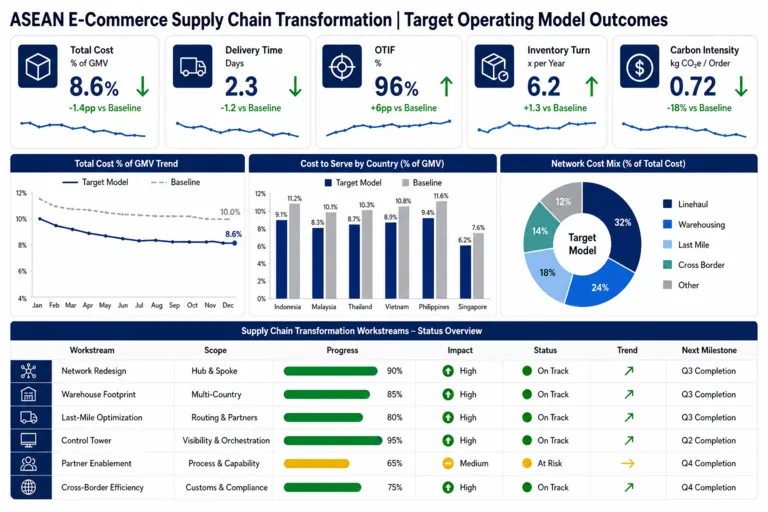
The transformation delivered faster, more reliable delivery at lower cost.
Network redesign and inventory optimisation reduced last-mile costs and improved delivery-time consistency, while real-time visibility cut exceptions and improved customer communication.
Cross-border streamlining reduced customs delays, and better forecasting lowered both stockouts and excess inventory.
The company strengthened its competitiveness in ASEAN's fast-growing e-commerce logistics market and built a scalable foundation for continued growth.